At the moment, cipher solutions are falling like ripe fruit from the trees. In just the past few days, I have reported on the solutions of the Wood Cryptogram, the Kaliningrad Cryptogram, and the Köhler Cryptograms. In all of these cases, artificial intelligence played a crucial role.
History may well remember the autumn of 2026 as the season when AI overtook humans in the art of codebreaking. A growing number of historical ciphers, some of which had resisted generations of talented cryptanalysts, are now yielding to AI-assisted approaches.
Dan Bourdeau’s project
One of the most impressive examples comes from Dan Bourdeau, a data scientist from the United States. Rather than focusing on a single puzzle, Dan approached the challenge methodically. He created a sophisticated agentic LLM setup designed to search the Internet for unsolved cryptograms and attempt their solution.
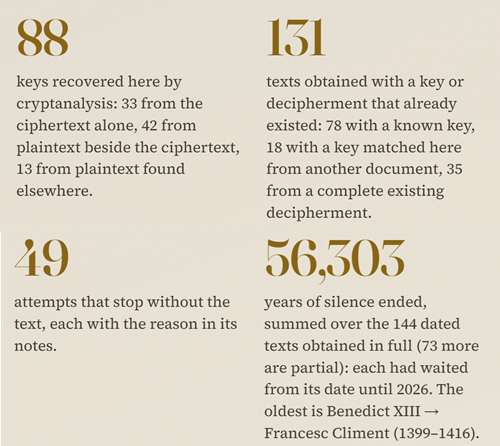
According to his website, Dan has so far collected 297 unsolved cryptograms. Some turned out not to be encrypted texts at all, while others were inaccessible or lacked sufficient information. Nevertheless, his system managed to solve 88 cases. Of these, 33 were solved from the ciphertext alone, 42 from ciphertext accompanied by plaintext, and 13 through plaintext recovered elsewhere. In a few instances, the system independently solved ciphers that had already been deciphered by other researchers.
Four of Dan’s successful decipherments might be familiar to readers of my old Cipherbrain blog:
The last of these is especially noteworthy, as it appeared on my (no outdated) list of the Top 50 Cryptographic Mysteries.
Another important source for Dan’s research was the DECODE Database, a collection of unsolved encrypted texts that unfortunately is not publicly accessible because of copyright restrictions. Most of its ciphers originate from historical archives. Experts believe that many tens of thousands of encrypted documents are still hidden in archives around the world. A large proportion stem from aristocratic correspondence or military contexts. Until recently, deciphering such a vast number of documents seemed impossible. AI is changing that assumption.
Dan also made extensive use of Satoshi Tomokiyo’s list of unsolved ciphers, which has become one of the most valuable resources for anyone interested in outstanding cryptographic mysteries.
The Voynich manuscript
An interesting finding emerging from Dan’s work concerns the Voynich Manuscript. His conclusion is straightforward: the manuscript is probably elaborate nonsense.
This assessment does not surprise me. There has recently been new work on the subject by Torsten Timm, and the accumulating evidence increasingly points in this direction. My own expectation is that even the most advanced AI system will never solve the Voynich Manuscript. The reason is simple: there may be no solution to find.
George Lasry
Dan’s work is supported by George Lasry, a name well known to many readers of this blog. To the best of my knowledge, George is the world’s most successful publicly known codebreaker. Of course, there may be cryptanalysts working for intelligence agencies or military organizations who have achieved even greater successes, but their accomplishments remain secret.
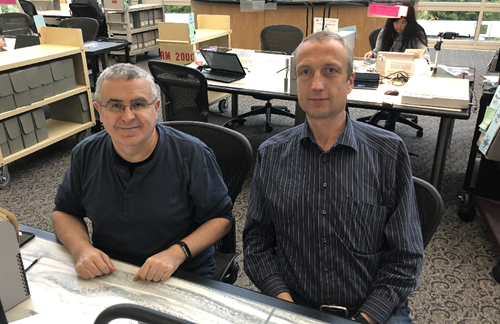
George reviewed Dan’s results and was deeply impressed. Together, Dan and George are now conducting a systematic study of the strengths and limitations of today’s frontier LLMs in classical cryptanalysis. Rather than relying on a single method, the models employ a wide range of approaches: linguistic analysis, systematic crib testing, ad hoc programming, hill-climbing attacks, archival research, source comparison, key reconstruction, and extensive searches for matching plaintexts or historical clues.
What is particularly striking is that the LLMs often succeed not because they invent fundamentally new cryptanalytic techniques, but because they relentlessly explore an enormous number of possibilities. They never get tired. They never lose concentration. They are perfectly willing to spend hours pursuing dozens of different hypotheses in parallel. In many cases, success comes from exploiting simple weaknesses that humans might overlook, such as alphabetically ordered keys or predictable naming conventions.
George himself has long embraced LLMs in his own work. He uses them extensively for labor-intensive tasks such as transcribing collections of cipher manuscripts, where current models often outperform traditional OCR systems, writing cryptanalytic software from detailed specifications, and performing tedious statistical analyses. However, he still prefers to reserve the most enjoyable aspects of cryptanalysis for himself: devising new attacks and exploring original ideas.
Outlook
For now, a few cipher challenges remain that only humans seem capable of solving. Yet it is increasingly difficult to believe that this situation will last. George would not be surprised if, within the next few months or next year, an LLM succeeded where generations of human cryptanalysts have failed and finally solved Kryptos K4. Several AI-powered attempts are already underway.
Projects such as Dan Bourdeau’s are rapidly exhausting the limited reservoir of unsolved historical ciphers. For decades, encrypted documents accumulated faster than scholars could decipher them. For the first time in history, the reverse may become true.
Perhaps future historians of cryptology will look back on the autumn of 2026 as a turning point. Not because a single famous cipher was solved, but because the balance of power shifted. For centuries, breaking codes was one of humanity’s most intellectually demanding pursuits. Now, increasingly, the machines are doing it better. And they have only just begun.
Back to Cipherbrain Blog