So much has happened in the world of cryptography and codebreaking over the past few weeks that I haven’t been able to blog about everything interesting that has crossed my path. Today, I would like to catch up on a few things that definitely deserve a mention.
The encrypted postcards of Dolly and Arthur
My friend Gerry Haynaly from Austria has published an interesting blog post about a series of encrypted postcards that were also featured on my old Cipherbrain blog.
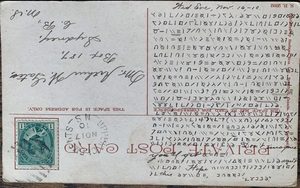
What makes Gerry’s article particularly interesting is that he does not only deal with deciphering the messages. He has also researched the story behind the postcards and the people who wrote them. This provides considerably more context to a cryptogram series that was already fascinating in its own right.
Napoleon’s encrypted letter deciphered
I have mentioned several times on this blog that AI is currently contributing to an unprecedented number of successful decipherments. One case I haven’t mentioned yet concerns a 217-year-old encrypted letter written by Napoleon. With the help of AI, researchers were able to decipher the message and shed new light on this historical document.
New website: Morse Code Transfer

Blog reader Mudassir Hussain recently pointed me to his new website, which is dedicated to Morse code. The site offers a broad range of Morse-related material, including Morse code converters, character sets, exercises, information about the history of Morse code, fun facts, and more.
Torsten Timm’s new work on the Voynich manuscript
Torsten Timm is a leading expert on the Voynich manuscript, although unfortunately I have never had the opportunity to meet him in person. Timm has long argued that the text of the Voynich manuscript does not encode meaningful language at all. According to his hypothesis, it was produced by a comparatively simple process that generated text without conveying an underlying linguistic message.
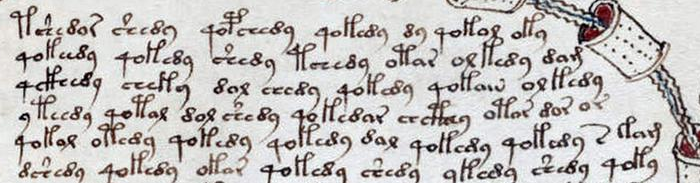
Personally, I think highly of this hypothesis. Unfortunately, it has received far less publicity than it deserves. Perhaps that is simply because the explanation is not spectacular enough. A mysterious medieval manuscript containing an unknown language or an ingenious cipher makes for a more exciting story than a text that may ultimately have no meaning at all.
Timm has now published another article in Cryptologia that provides further information supporting this line of research. Unfortunately, the paper is behind a paywall.
I hope that this publication will help Timm’s work finally receive more of the attention it deserves. And I particularly hope that it will not get lost amid the numerous AI-based pseudo-solutions to the Voynich manuscript that are currently circulating.
Back to Cipherbrain Blog