At the moment, one decryption breakthrough follows another. As I have mentioned several times before, thanks to AI, we are currently witnessing a wave of breakthroughs in historical cryptanalysis unlike anything we have ever seen before – and probably anything we will ever see again.
Today’s breakthrough comes from Ilia Slovesnyi, editor of Hi, AI!, a project exploring AI, technology, and the people behind them. Ilia is 27 and comes from Saint Petersburg, Russia. He took on a cryptogram from my old Cipherbrain blog as an experiment to see how far someone with no background in cryptography could get by relying on AI alone to crack a cipher. It took him less than two hours to find the solution.
 Source: Ilia Slovesnyi
The cryptograms in question are previously unsolved encrypted telegrams from the German battleship Schleswig-Holstein.
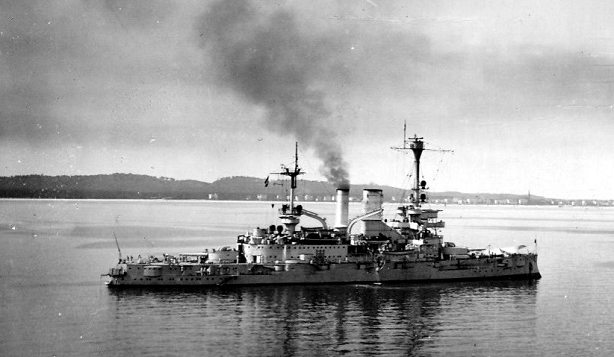
The Schleswig-Holstein
The battleship Schleswig-Holstein, named after the German state of Schleswig-Holstein, was built between 1905 and 1908. She served in both World Wars. During World War I, she saw front-line action at the Battle of Jutland.
 Source: Wikimedia
As one of the few battleships Germany was permitted to retain under the terms of the Treaty of Versailles, the Schleswig-Holstein continued to serve in the German fleet throughout the 1920s. In 1935, she was converted into a training ship. She spent most of World War II in this role before being sunk by British bombers in December 1944.
An encrypted telegram
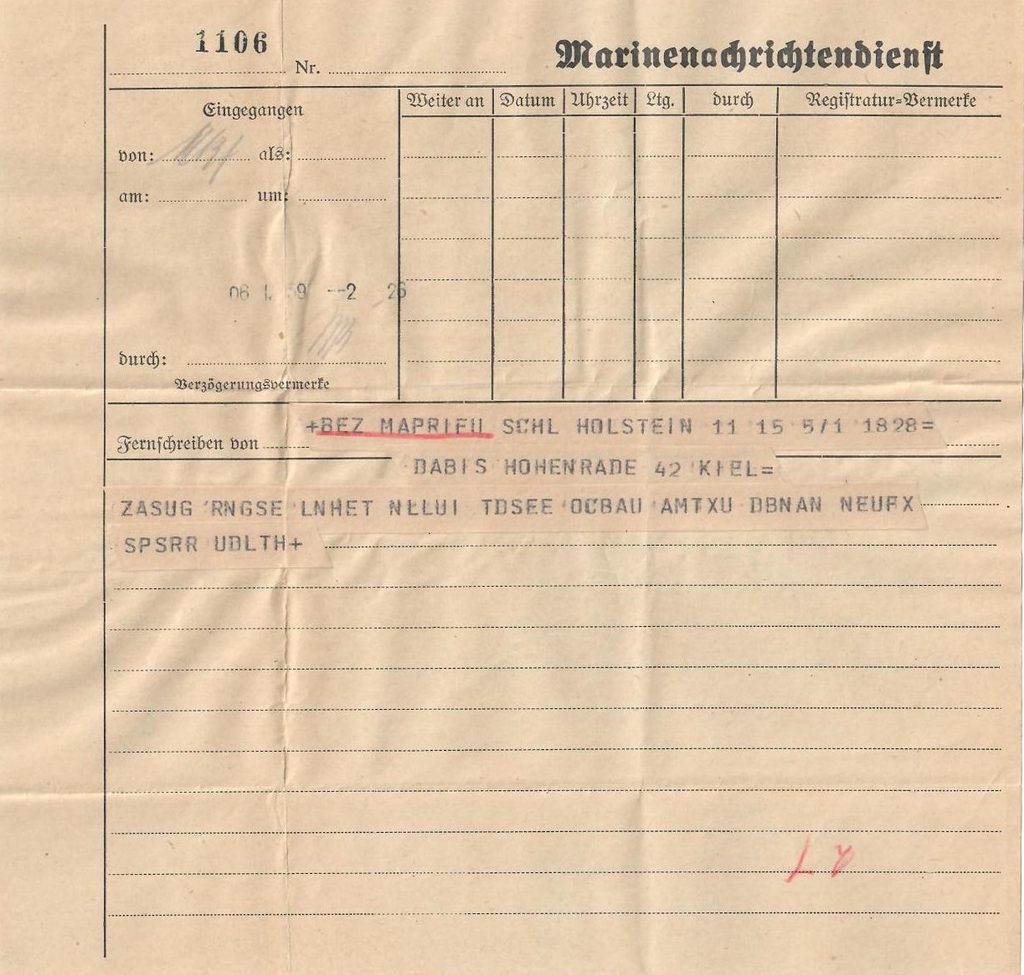
My friend Tobias Schrödel, known, among other things, as a comedy hacker, an author, and an expert on historical ciphers, owns a fascinating document: an encrypted teleprinter message sent from the Schleswig-Holstein to a private household in Kiel, Germany, in 1939. Here it is:
 Source: Tobias Schrödel
Here’s a transcript of the encrypted part:
ZASUG RNGSE LNHET NLLUI TDSEE OCBAU AMTXU DBNAN NEUFX SPSRR UDLTH+
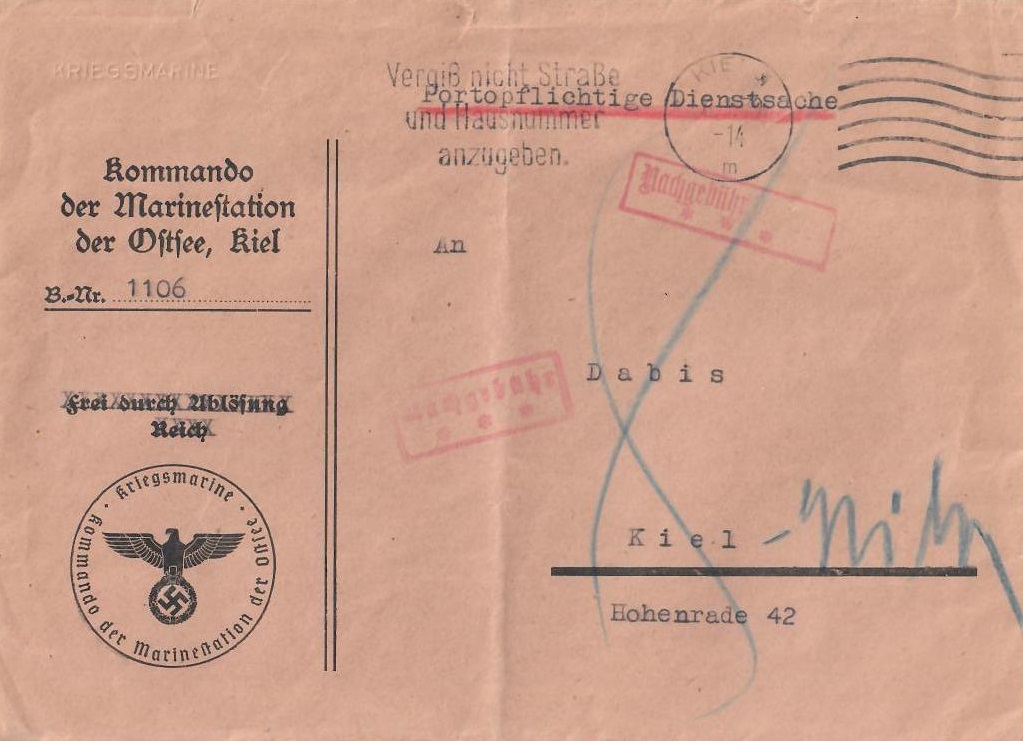
This message was contained in the following envelope:
 Source: Tobias Schrödel
The recipient of these notes was a person or family named Dabis in Kiel, Germany. The letter was stamped on January 6, 1939, in Kiel.
Three more Schleswig-Holstein telegrams
In 2021, Patrick Hayes sent me three more encrypted messages that had been sent from the Schleswig-Holstein to the Dabis address in Kiel. Here is the first of the encrypted messages in Patrick’s trove:
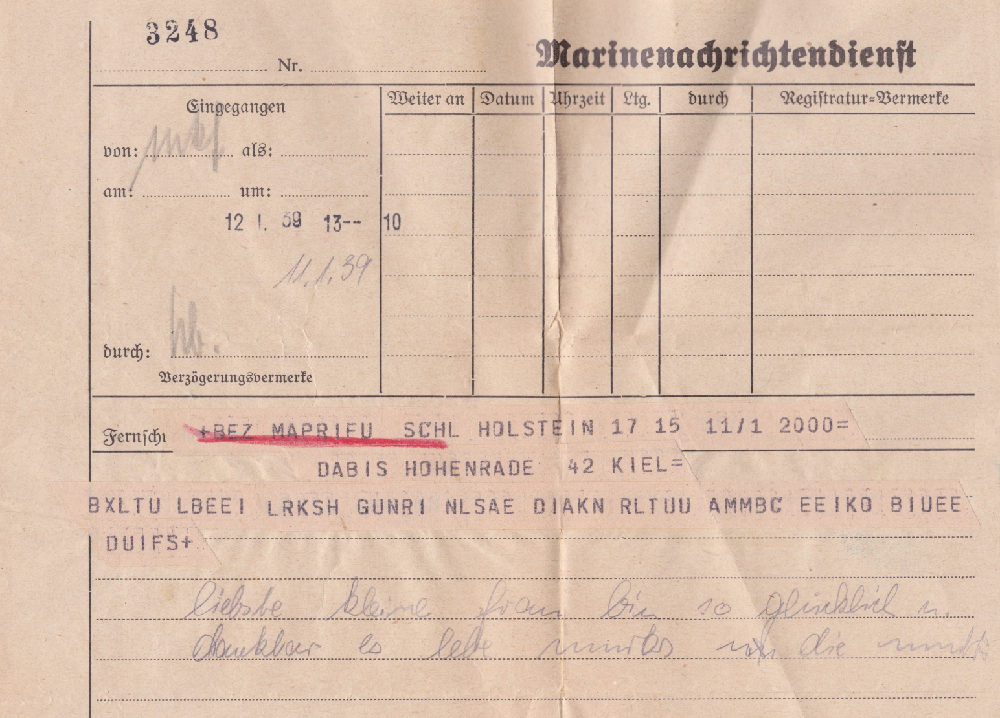 Source: Patrick Hayes
Patrick’s cryptogram number 2 follows:
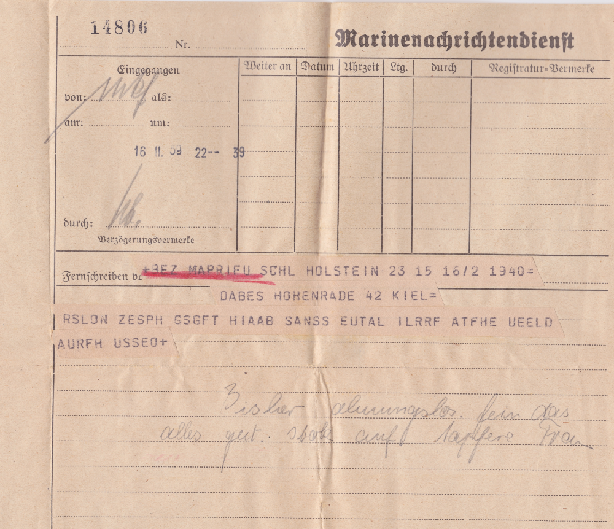 Source: Patrick Hayes
And finally, the last ciphertext in this series so far:
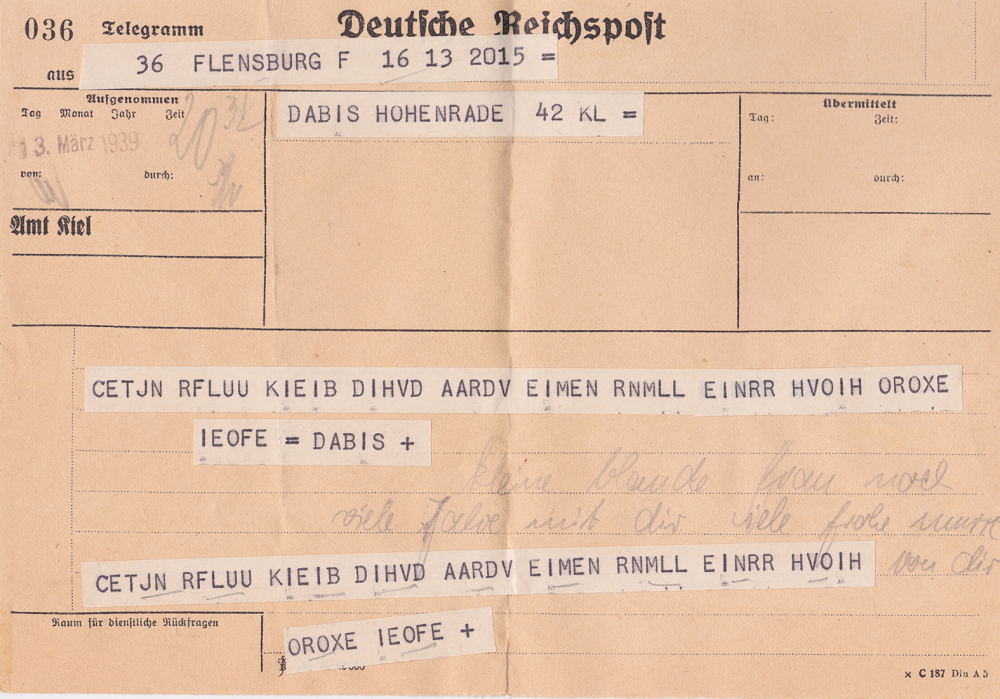 Source: Patrick Hayes
Ilia’s decipherment
Ilia recently came across these four cryptograms on my old Cipherbrain blog. With the help of Claude Opus 5.5, he deciphered the telegrams and recovered the cipher system with the keys for all four messages. Here is the first telegram (January 5, 1939, 18:28):
Ciphertext: ZASUG RNGSE LNHET NLLUI TDSEE OCBAU AMTXU DBNAN NEUFX SPSRR UDLTH
Plaintext: ZUR GROSSEN STUNDE HALS UND BEINBRUCH UND X GLATTEN STAPELLAUF M X
My blog reader H. B. had discovered that “Murks” was the nickname of the Dabises’ child, who was born in January 1939. We can therefore interpret “glatten Stapellauf” as a sailor’s joke wishing his wife an easy delivery. The X following UND appears to serve as a separator, while the final M X most likely merely fill the remaining cells in the 55-character grid.
The system turned out to be the triangle blog reader Norbert proposed in 2017:
- The message is fitted to exactly 55 letters; Dabis shortened words where needed (LIBSTE, GLUKLICH, VILE).
- It is written row by row into a triangle of 1, 2, …, 10 cells.
- A ten-digit key, with each digit from 0 to 9 used once, is written over the ten columns.
- The columns are read out in the order of their digits.
- Within each column, the rows (numbered 0 to 9 from the top) are taken in the order in which their numbers appear in the key. This is why fixed routes through the triangle never worked.
- The 55 letters are sent in 11 groups of five.
Here are the keys:
- No. 1 — 0931276845;
- No. 2 — 1093276548;
- No. 3 — 2193076458;
- No. 4 — 1590276348.
Ilia has made a video that shows the cipher step by step. The full story, including all plaintexts, is available on his Substack and Telegram channel, while the code that reproduces every result is provided on GitHub.
The solution stands on my readers’ work: Norbert’s triangle, the transcriptions and readings by Gerd, Michael (BGNC) and Gerry, Norman K.’s dates and H.B.’s note on Murks.
Back to Cipherbrain Blog