Right now, encrypted messages are falling like ripe fruit. Today, I’d like to revisit another cryptographic puzzle that once featured on my (now outdated) Top 50 list and has since been solved: the Catokwacopa cryptograms.
Two mysterious ads
The Catokwacopa cryptograms are two newspaper ads that appeared in the Evening Standard in May 1875, twelve days apart. “Catokwacopa cryptograms” is the first word of the first advertisement. Here it is (May 8, 1875):
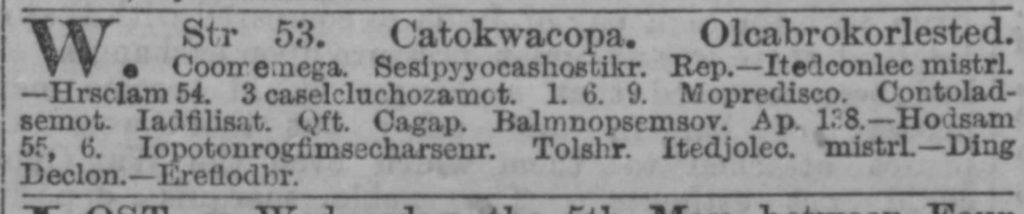
This is the second one (May 20, 1875):
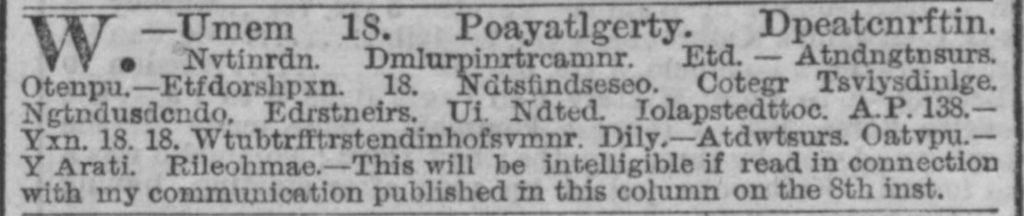
The second advertisement ends with a passage in plain English: “This will be intelligible if read in connection with my communication published in this column on the 8th inst.” In other words, the two advertisements are meant to be deciphered together. The letter frequencies correspond to those of English, suggesting that a transposition cipher was used.
Thomas Ernst’s decryption
Coincidentally, I blogged about the Catokwakoa cryptograms a few weeks ago. Before that, these two messages had been discussed several times on my old Cipherbrain blog.
What I unfortunately overlooked: As early as 2018, Thomas Ernst published a decryption on my old Cipherbrain blog that was largely correct. However, I didn’t realize this until Gerry Haynaly pointed it out to me. Thomas Ernst, in turn, pointed to blog readers Lance Estes and Dave, who had done important preliminary work. Jozef Krajcovic and Richard SantaColoma also provided interesting insights. George Lasry then provided a detailed description of the decryption. Jussi Mullo summarized all the findings on a website. Here’s another summary by Dan Bourdeau.
Deciphering the Catokwacopa cryptograms was thus a collaborative effort by several of my blog readers. AI played only a minor role in the process, though this will likely no longer be the case with such ciphers in the future. In any case, thanks to everyone involved.
The Solution
The deciphering method follows the following pattern:
- Take the nth word from both the first and second ads and merge them into a coherent text.
- The order of the letters in the original words must not change.
- In some places, a letter must be added.
- The letter after a gap is usually in the second ad, and so is the last printed letter of a word.
Unfortunately, this is not a precisely defined algorithm, as a cryptologist would hope. Nevertheless, it allows the plaintext to be reconstructed without too much ambiguity. In fact, a transposition cipher was used. It is striking that, in the first message, the encoder took care to ensure that the resulting words could be pronounced (CA-TO-KWA-CO-PA, MO-PRE-DIS-CO).
Here is the plaintext:
Summer term 1853. Cap took away at college party. Old cap, broke at corner, left instead. Convo (?) met me in garden, said simply: “Your cap is honest …” Repeated.
I attended Conington’s lectures. … [pupil]. Hertford scholarship examination, March 1854. Candidates, self included, chose [to seize a motto]: Odes 1.6.9. Mottos privately discussed in college. Conington told us to add a second motto. I added first line of Satires: Qui fit. [Change adopted.] Baliol man opposite [seemed, sotto voce: Ars Poetica 138.]
Hody’s examination 1855-6. [Jowett put on] Robert Griffith first, me second, [in harsh and offensive manner]. Told Shirley. I attended Jowett’s lectures. … [visitor pupil].
Dying declaration. [Retire, followed both master.]
This is probably written by a student who is reporting on some lectures, exams, and other events. Can any readers provide more details? Robert Griffith must be a fellow student of the author. But why would someone write something like this in a coded newspaper ad? And who is the recipient? I’d appreciate any clues.
Back to Cipherbrain Blog