September 2026 will definitely go down in the history of codebreaking. Never before have so many unsolved cryptograms been deciphered in such a short period of time. The culprit, of course, is AI.
These days, hardly a day goes by without me receiving at least one email pointing me to a supposedly solved cryptogram. In almost every case, AI was involved in the solution. Unfortunately, many of these alleged solutions turn out to be wrong. And unfortunately, this is not always obvious at first glance. Much of what AI produces looks perfectly plausible.
Despite all the nonsense, however, there are also genuine successes. September 2026 may therefore well go down in history as the month when AI overtook humans in codebreaking. One amusing side effect is that AI apparently recommends my website fairly often when discussing unsolved cryptograms. This has resulted in quite a few interesting messages landing in my inbox.
Today, I want to report on the solution of the Copenhagen Cryptogram. I first presented this previously unsolved cryptogram on my old Cipherbrain blog in 2015 and included it in my list of the Top 50 Unsolved Cryptograms.
The Copenhagen cryptogram
Sometime after the Second World War – probably at the end of the 1950s – an employee of a military museum in Copenhagen came across an encrypted message. It was written on a piece of paper that had been hidden on the back of a painting from 1835 depicting a Danish general. Here is the message:
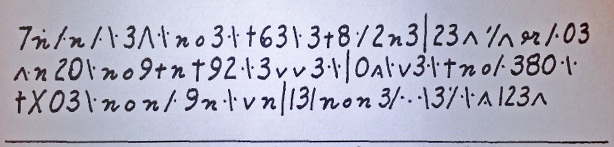
The staff of the military museum were unable to decipher this message. They therefore sent it to the American Cryptogram Association (ACA). However, ACA members who tried to break the cipher were not successful, either.
Many of my blog readers examined the Copenhagen cryptogram, too, but to no avail.
The solution
A few days ago, I received an email from Ólafur Waage, an Icelandic software developer living in Norway.

Ólafur told me that he had solved the Copenhagen Cryptogram with the help of AI. The plaintext he found is old Danish and reads as follows:
min inderlig elskede sophie
her bringer ieg dig et siste levvel
gud velsigne og ledsage dig intil vi ses igien
? e blucher
Translated approximately, this means:
My dearly beloved Sophie,
Here I bring you a final farewell.
God bless and accompany you until we meet again.
?e Blucher
And here is the key:
X -> a or æ
‘/ -> b
I -> c (short vertical stroke)
\. -> d
3 -> e
o (or 0) -> g
2 -> h
n -> i (it’s also the unusual glyph near end of line 1)
6 -> k
.\. -> L (I upper cased it so you see the difference)
7 -> m
/. -> n
8 -> o
./ -> p
alpha -> r
+ -> s
9 -> t
alpha with dot inside -> u
v -> v
.\ -> unknown (it’s only once in the cryptogram)
So, the cipher is a monoalphabetic substitution. It is quite remarkable that nobody managed to crack this cryptogram for so many decades. Perhaps the language barrier played a role. A Danish plaintext is, after all, not necessarily the easiest target for an English-speaking cryptogram solver.
The plaintext
But what does the message actually mean? According to Ólafur, the plaintext could be a quotation from Fredrik von Blücher (1760-1806), addressed to Sophia of Mecklenburg-Schwerin (1758-1794).
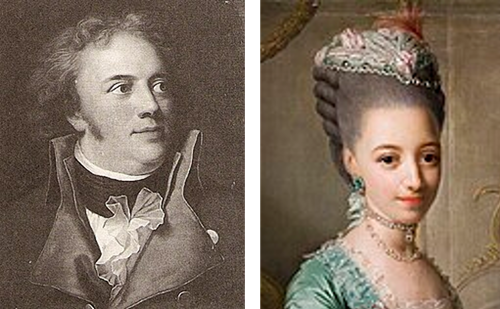
Sophia died before Fredrik did, and he was known as her secret lover. The message could therefore be a secret letter from him to her, especially since the two were never actually married. This interpretation would certainly make the hidden message rather more interesting than an ordinary military note.
But it also raises other questions: Was the message deliberately hidden behind the painting? Was the encryption intended to keep a personal relationship secret? Or is there another story behind the cryptogram that we don’t know yet?
If anyone has an idea, I would be very interested to hear it.
Many thanks to Ólafur Waage for solving this long-standing cryptographic mystery – with a little help from AI.
Back to Cipherbrain Blog