Back in the days of my former Cipherbrain blog, I maintained a list of the 50 most important unsolved cryptograms. Several have been solved since then.
The message
One cryptogram on that list consisted of a page of encrypted German radio traffic from World War I. The messages were enciphered with the ADFGVX cipher, one of the most sophisticated field ciphers used by Germany during the war. The telltale sign of an ADFGVX message is easy to spot: it contains only the six letters A, D, F, G, V, and X. Each pair of these symbols represents a plaintext character, after which a transposition step based on a keyword is applied. The letters A, D, F, G, V, and X were chosen because their Morse code representations differ clearly from one another, reducing the risk of transmission errors.
The message in question reads as follows:
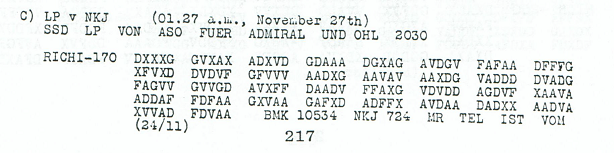
Here is a transcript:
DXXXG GVXAX ADXVD GDAAA DGXAG AVDGV FAFAA DFFFG
XFVXD DVDVF GFVVV AADXG AAVAV AAXDG VADDD DVADG
FAGVV GVVGD AVXFF DAADV FFAXG VDVDD AGDVF XAAVA
ADDAF FDFAA GXVAA GAFXD ADFFX AVDAA DADXX AADVA
XVVAD FDVAA
Hundreds of ADFGVX messages transmitted between July and December 1918 were preserved by a U.S. Army officer named James Rives Childs. They were later published in his book General Solution of the ADFGVX Cipher System, released by Aegean Park Press in 2000. In recent years, George Lasry, one of today’s most accomplished cryptanalysts, solved many of the remaining unsolved Childs messages. A handful resisted all efforts, however, and therefore earned a place on my Top 50 list.
The solution
Now, thanks to blog readers Gerry Haynaly and Andreas Barchfeld, I have learned that one of these lingering mysteries has finally been cracked. The solution was reportedly produced by GPT-6 Astra, according to a post published by a developer known as Prinz on his website Prinz.ai. The article links to my old Top 50 list.
According to the published solution, the plaintext reads:
EIN ENGLISCHER KREUZER EINLIEG X SEWASTOPOL X S4STEN X EIN GESCHWADER DER X ALLIIERTEN FOLGT 26STEN X
Translated into English:
AN ENGLISH CRUISER ARRIVED AT SEVASTOPOL ON THE ?4TH. AN ALLIED SQUADRON FOLLOWS ON THE 26TH.
The keyword used to decrypt the message is: TRUPPENVERSCHIEBUNG (“troop movement”).
Interestingly, this keyword was already known to researchers. According to Astra’s analysis, the mystery lay elsewhere. The keyword TRUPPENVERSCHIEBUNG was apparently introduced on 9 December 1918, while the message itself was transmitted on 27 November 1918. If this dating is correct, then the message appears to have been encrypted with a key that should not yet have been in use. Why this happened remains unclear. Was the date of the message recorded incorrectly? Did the operators begin using the key earlier than previously believed? Or was there an exception to the normal key schedule? At this point, nobody seems to know.
The fact check
What makes this story even more remarkable is that Astra reportedly went beyond the decryption itself. According to Prinz’s report, the AI attempted to verify the result by checking whether the historical circumstances matched the recovered plaintext. In particular, it investigated the presence of British naval forces in the Black Sea around the relevant dates and concluded that the message was historically plausible.
One immediate consequence is that my old Top 50 list has become one entry shorter. This is a problem I am very happy to have.
Back to Cipherbrain Blog