Artificial intelligence is currently enjoying a remarkable run in the world of cryptanalysis. Hardly a week goes by without a new claim that an old cipher has been solved with the help of an AI model. Unfortunately, not every one of these announcements withstands closer scrutiny.
A recent example came from the blog Vals.ai, which reported the decipherment of two encrypted texts by the Scottish polymath Thomas Urquhart (1611–1660). These cryptograms were important enough to earn a place on my list of the 50 most important unsolved historical ciphers. At first glance, the reported solution looked convincing. However, a closer examination revealed several inconsistencies. It seems that the AI had produced what is now becoming a familiar phenomenon: a result that sounds convincing but turns out to be wrong.
An Enigma challenge that survived for two decades
Fortunately, there are also examples that point in the opposite direction. One interesting success story of this kind was recently published. It concerns an Enigma message from the Second World War.
Millions of Enigma messages were transmitted during the war. Most of them were never archived and are lost forever. Nevertheless, several thousand have survived in archives, collections, and intelligence records. During the last two decades, specialists such as the Norwegian cryptologic researcher Frode Weierud and the German Enigma expert Michael Hörenberg have devoted considerable effort to recovering and deciphering these surviving messages.
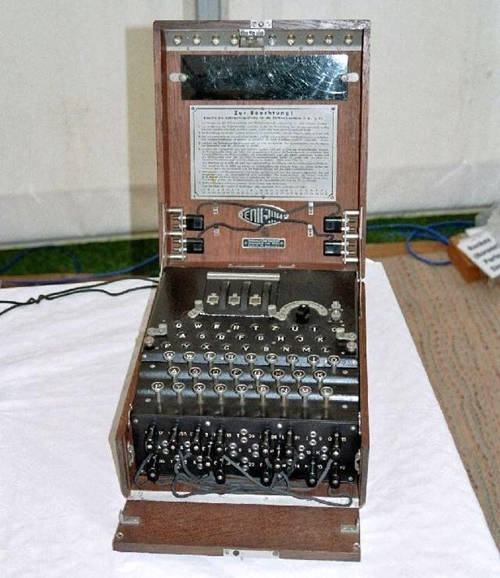
In most cases, modern computing power and sophisticated search algorithms make the task manageable. What once required the resources of Bletchley Park can often be achieved today on comparatively modest hardware.
Yet some messages have resisted all attempts. Usually these are messages that are exceptionally short, contain transmission errors, suffer from inaccurate archival transcriptions, or were encrypted with an unknown Enigma type. Such cases can remain unsolved for years.
Enter GPT-6 Astra
According to a report by Bloomberg’s Carter Leffen, an Enigma message known by the identifier MVUEH was finally deciphered with the assistance of GPT-6 Astra and a collection of cooperating AI agents.

The encrypted message dates from 10 July 1941 and consists of 82 ciphertext letters. It had appeared on Frode Weierud’s website as an unsolved Enigma challenge since 2005. Two known Enigma keys used on the same day had already been tested without success.
The breakthrough reportedly came during a research effort conducted on September 14 and 15, 2026. Leffen directed the work while Astra and several parallel AI agents examined archival material, evaluated alternative readings of difficult handwritten characters, generated software for key searches, and verified candidate solutions.
An important clue came from another Enigma message, SIPVX, which had been solved years earlier. In that message, the place name “Rosenow” appeared twice in succession. This observation led researchers to suspect that the sequence ROSENOWROSENOW might be a crib.
Billions of possibilities
The surviving records of MVUEH were not easy to work with. Certain handwritten characters were ambiguous, and researchers ultimately identified twelve positions where the transcription could plausibly be interpreted in more than one way. The final reconstruction differs from earlier transcriptions by three characters.
Astra reportedly generated Enigma simulation software as well as cryptanalytic tools in Python and C++. Under the specified assumptions, the system evaluated roughly 4.29 billion combinations involving crib positions and rotor arrangements. Once a promising candidate emerged, an additional 14.8 million Enigma key settings were tested against the preserved message header.
The resulting configuration was:
- Rotor order: II–V–III
- Ring settings: H–M–F
- Initial position: R–W–D
- Ten plugboard connections
Two independent Enigma implementations successfully decrypted and re-encrypted both the message body and the message header using these parameters. This is exactly the kind of verification cryptologists like to see.
What did the message say?
The resulting plaintext appears to be a rather ordinary military communication:
BTTE UM ANGABE DES MARSQWEGES X
BEFINDE MIQ IN X ROSENOW ROSENOW X
SOFORT FUNKANTWORT X WASCHBBSCH
The sender requested information regarding a further route, stated that he was in Rosenow, and asked for an immediate radio reply. Researchers have not yet determined with certainty which Rosenow was meant. The sender’s signature is tentatively interpreted as “Waschbusch”.
Frode Weierud confirmed the result. According to him, previous attempts may have failed because of transcription errors in the archival record and because of an unusual rotor turnover near the end of the message.
Back to Cipherbrain Blog