At the HistoCrypt 2026, I came across an encrypted document, which was exhibited by French radio history expert Didier Clarençon.
This document was reportedly found on eBay in 2009 together with a spy radio suitcase, as it was used by the British Special Operations Executive (SOE).
According to Didier, the sheet is an original encrypted message that was to be transmitted by a French Resistance radio operator in 1944.
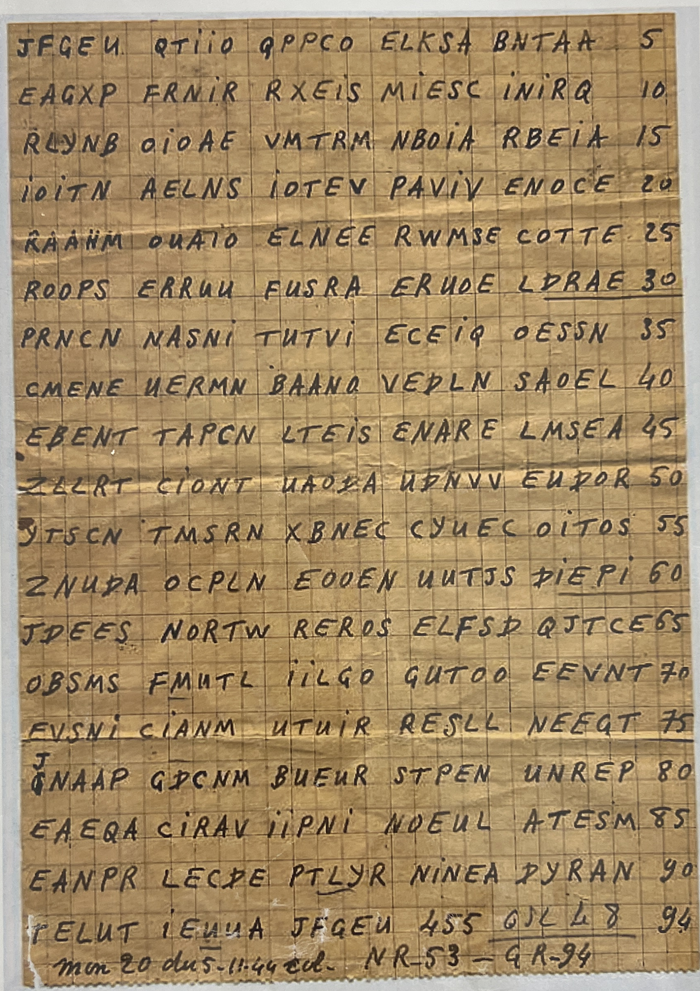
The ciphertext is divided into groups of five letters. Every fifth group is numbered, allowing the receiving station to request the retransmission of a specific block if reception was poor. The message contains 93 groups of five letters, for a total of 465 letters. At the bottom appears the number 455, indicating the actual length of the message to be transmitted. This is standard practice, as indicator groups were usually excluded from the length count.
The first and last groups are identical: JFGEU. These are almost certainly repeated indicator groups used to derive the encryption key. In addition, the second group (QTIIO) appears to be a special encrypted prefix rather than part of the actual message. According to the accompanying notes, this prefix was itself encrypted with a Playfair cipher and informed headquarters about the coding procedure used by the operator.
If this interpretation is correct, the actual ciphertext consists of 450 letters, not 455. The transmitted length of 455 might therefore have been deliberately misleading – perhaps to confuse German codebreakers.
A Double Transposition?
Here is an AI-generated transcript of the message:
JFGEU QTIIO QPPCO ELKSA BNTAA

EAGXP FRNIR RXEIS MIESC INIRQ

RLYNB OIOAE VMTRM NBOIA RBEIA

IOITN AELNS IOTEV PAVIV ENOCE

RAAHM OUAIO ELNEE RWMSE COTTE

ROOPS ERRUU FUSRA ERUOE LDRAE

PRNCN NASNI TUTVI ECEIQ OESSN

CMEME UERMN BAANO VEDLN SAOEL

EBENT TAPCN'LTEIS ENARE LMSEA

ZLLRT CIONT UAODA UDNVV EUDOR

YTSCN TMSRN XBNEC CYUEC OITOS

ZNUDA OCPLN EOOEN UUTJS DIEPI

JDEES NORTW REROS ELFSD QJTCE

OBSMS FMUTL IILGO GUTOO EEVNT

FVSNI CIANM UTUIR RESLL NEEGT

JNAAP GDCNM BUEUR STPEN UNREP

EAEQA CIRAV IIPNI NOEUL ATESM

EANPR LECDE PTLYR NINEA DYRAN

TELUT IEUUA JFGEU
The following frequency analysis was made with Christian Baumann’s Multi-Dec page:
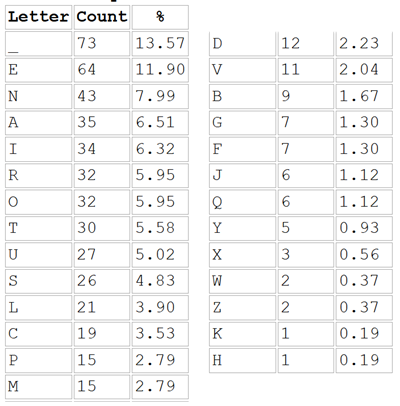
The letter frequencies are very similar to those of the French language. Since SOE and the French Resistance mainly used One-Time Pads and Double Transposition during 1944, and because the letter frequencies clearly do not resemble OTP-encrypted text, the obvious candidate is a Double Transposition Cipher (DCT). If this assumption is correct, the two transposition keywords were probably between 15 and 35 letters long. The message might also contain a few null letters at the beginning or end to make the total length divisible by five.
One particularly intriguing observation concerns the probable contents of the plaintext. In many surviving SOE messages, operators included the date on which they wrote the message. If this convention was followed here, the plaintext may contain the French phrase “mon vingt du cinq onze quarante quatre” (“my twentieth of the fifth, 1944”). This date would not appear at the beginning or end of the message but somewhere in the middle of the text, making it a potentially useful crib.
Can it be solved?
Double Transposition Ciphers are very secure against manual cryptanalysis but often vulnerable to modern computer-assisted hill-climbing techniques. Unfortunately, a 450-letter French ciphertext encrypted with unknown keys is still a formidable challenge. To my knowledge, nobody has successfully decrypted this message.
Perhaps this mysterious Resistance message will eventually yield its secrets after more than eighty years. I would be delighted to hear your ideas in the comments.
Back to Cipherbrain Blog