Pollaky’s encrypted newspaper ads

Ignatius Pollaky (1828-1918) was one of the best-known private investigators of his era. Born in Bratislava and later active in London, he built a formidable reputation as a detective and is sometimes described as a real-life inspiration for Sherlock Holmes. Like Arthur Conan Doyle’s fictional investigator, Pollaky appears to have possessed an interest in secret writing and ciphers.

The encrypted ads

The cryptograms surfaced in newspaper advertisements, a common communication channel in the nineteenth century. At the time, newspapers often contained coded personal messages, business arrangements, and covert communications hidden in plain sight. Pollaky placed several such advertisements, some of which were encrypted. Researchers have identified at least a dozen advertisements linked to him, including multiple unsolved cryptograms.

Four of the Pollaky cryptograms have attracted particular attention. One, published in May 1865, appears to use a mysterious secret script rather than an ordinary substitution cipher.

Two additional encrypted advertisements from May 1875 use yet other formats, suggesting that Pollaky may have experimented with multiple encryption systems rather than relying on a single method.

Another, dating from 1871, employs a numerical code.

xxxx

Analysis

The first Pollaky cryptogram is the strangest. It consists of only eleven symbols, with just one repetition. This makes traditional cryptanalytic methods almost useless. Frequency analysis and probable word search cannot be applied to such a short text. Unless additional ciphertext emerges or someone recognizes the symbols themselves, solving this message may remain impossible.

Equally curious is the choice of symbols in a newspaper advertisement. In a medium where advertisers paid for space, using unusual characters instead of ordinary letters or numbers would likely have been more expensive and certainly less practical. A message written with letters or digits would have been easier to compose and reproduce.

The symbols are quite complex in structure, which suggests that there is a large alphabet. Meine Vermutung ist, dass es mehrere Hundert dieser Zeichen gibt, und dass jedes davon eine Codegruppe in einem Codebuch oder Nomenklator bildet.

Denkbar wäre auch, dass Morse xxxx

The remaining three encrypted advertisements may have been enciphered with the aid of a codebook, in which words or numbers represented prearranged meanings.

The “MIDNIGHT VISITOR” advertisement is not encrypted in the strict sense. Instead, it was probably a message whose meaning had been agreed upon in advance.

More than 150 years later, the Pollaky cryptograms remain unsolved. Whether they concealed detective business, private arrangements, or something entirely unexpected, their secrets continue to resist discovery.

Unfortunately, the surviving material offers few clues. According to research by author Bryan Kesselman, Pollaky destroyed his records after retirement, eliminating what might have been the key to understanding his methods. Although hundreds of Pollaky letters survive in archives in Britain and the United States, none appears to reveal the principles behind his cryptographic systems.

This makes the Pollaky cryptograms a rare historical puzzle: authentic encrypted messages created by a celebrated detective, preserved for more than 150 years, yet still resistant to analysis. Were they practical secret communications, professional detective tools, or merely experiments in concealment? For now, the answers remain hidden in Pollaky’s code.

Literature

Klaus Schmeh, Elonka Dunin: Codebreaking: A Practical Guide. No Starch Press 2023

Back to Unsolved Crypto Mysteries

Kryptos

Kryptos is the world’s most famous cryptographic artwork. Installed at the headquarters of the Central Intelligence Agency (CIA) in 1990, the work bears an encrypted inscription, a part of which is still unsolved. The sculpture comprises four large copper plates with other elements consisting of water, wood, plants, stone, and petrified wood. The characters are cut out of the copper plates.  Kryptos is not open to the public. 

Source: Dunin

Kryptos was created by the American artist Jim Sanborn, whose work combines sculpture, language, science, and cryptography in unique and thought-provoking ways. Over the years, I had the opportunity to meet Jim Sanborn on several occasions and exchange ideas about Kryptos, its hidden messages, and the remarkable community that has formed around the sculpture. These encounters offered valuable personal insights into one of the most fascinating works of cryptographic art ever created.

Over the years, a large and passionate community of Kryptos solvers has emerged, united by the challenge of deciphering the sculpture’s remaining secrets. The community is led by U.S. cryptography expert Elonka Dunin, a close friend with whom I have collaborated extensively, including co-authoring a book.

The encrypted inscription

The sculpture contains four encrypted sections, commonly referred to as K1, K2, K3, and K4. These sections are not visually separated from one another, creating the impression of a continuous encrypted text. K1, K2, and K3 have been successfully deciphered. The first known solution of these parts was achieved in 1992 by the National Security Agency, although this breakthrough was not publicly disclosed at the time. In 1998, David Stein, an employee of the Central Intelligence Agency who passed the sculpture almost daily on his way to work, independently solved K1, K2, and K3. This solution also remained unpublished at first.

In 1999, renowned cryptography expert Jim Gillogly independently solved K1, K2, and K3 and publicly released his findings. Only afterward did it become known that both the NSA and the CIA had successfully solved the same sections years earlier.

K4

K4 remains unsolved to this day. It consists of a sequence of 97 encrypted characters and represents the final, unresolved section of Kryptos.

                           OBKR
UOXOGHULBSOLIFBBWFLRVQQPRNGKSSO
TWTQSJQSSEKZZWATJKLUDIAWINFBNYP
VTTMZFPKWGDKZXTJCDIGKUHUAUEKCAR

Here is K4 on the sculpture:

Despite decades of analysis by professional cryptographers, intelligence agencies, mathematicians, and enthusiasts around the world, no definitive solution has yet been found — making K4 one of the most famous unsolved cryptographic puzzles in the world.

The Clues

Over the years, Jim Sanborn has provided four clues to solving K4. Each clue consists of one or more plaintext words and their positions:

  • 2010: The sixty-fourth through sixty-ninth positions of K4 are BERLIN.
  • 2014: The word CLOCK follows BERLIN in the K4 plaintext.2
  • January 2020: The word NORTHEAST appears at positions 26 through 34.
  • August 2020: An additional word, EAST, appears at position 22.

Here are the words in the encrypted text:

Decades after its installation, Kryptos continues to inspire cryptography enthusiasts around the world.

Literature

Klaus Schmeh, Elonka Dunin: Codebreaking: A Practical Guide. No Starch Press 2023

Back to Unsolved Crypto Mysteries

The Fair Game code

The film Fair Game from 2010 is a political thriller. Naomi Watts and Sean Penn play a married couple who get caught up in the mills of the secret services.

In 2014 blog reader Ralf Jäger alerted me to the fact that several dozen letters are highlighted in yellow in the five-minute credits. Together, they make up the following message (the question mark stands for a hidden and therefore unknown letter):

ces?oapchfhteopisfmnadamecaoredatn
rayuurnqwknufrcojrwrmdgeushwtokara

The meaning of these letters is unknown to this day. If it is a coded text (which of course is not said), it is unsolved. The plain text language should be English, because it is a movie from the USA.

Rossignol’s transcript

Blog reader Rossignol, an experienced codebreaker from France, kindly provided me with the entire Fair Game transcript in the form of high quality screenshots. Here is an example:

BFG11

Source: Rossignol

The complete set is available here. As you can see on the following screenshot, some of the last names are covered with a white bar (probably for legal reasons):

BFG02

Source: Rossignol

In the screenshot below, you can see that one of the highlighted letters is contained in a hidden last name. This explains the question mark in the message:

BFG03

Source: Rossignol

Analysis

The frequency distribution of the letters (calculated with CrypTool):

Source: CrypTool

The frequency distribution is uneven and consistent with a monoalphabetic substitution cipher (MASC). The letter A, with a frequency of approximately 12%, could potentially represent the letter E, the most common letter in English. In general, a sample of 67 letters is usually sufficient for a meaningful frequency analysis when a letter substitution cipher has been used.

However, none of these observations has so far led to a successful decryption of the text.

The comment by Martin Halpin

A reader who called himself Martin Halpin wrote the following comment on my first Fair Game blog post:


Translation: Don’t focus on the yellow letters, better interprete thems as markers for the letters to follow.

Does this tip come from an insider? In any case, Martin Halpin only posted this one comment on my blog. It could be that the production company hopes to get the code search going with such a hint, so that the Fair Game cryptogram finally brings the desired publicity.

The pseudonym “Martin Halpin” could be based on a gardener of the same name in James Joyce’s novel “Finnegan’s Wake.” This name also appears in the novels “The Glass Key” (1931) by Dashiell Hammett and “Mulligan Stew” by Gilbert Sorrentino.

If reader Martin Halpin is correct, then it is not the letter highlighted in each case that is relevant, but the letter following it. A blog reader named CJ wrote in response:

I think maybe you should focus on the letters next to the yellow letters.

Combine all the letters that are exactly left of each yellow letter, or combine all the letters that are exactly right of each letter, or combine both all the letters that are exactly left and right of each yellow letter.

From those groupings of letters try to crack the code.

Richard SantaColoma and Racingdevil48 sent me the sequence of letters that results when you take the letter to the right of the highlighted one each time:

TAT?DMOTAEAYEPMLEFCICEASEARTIRINSE
ORANAEOUIUGLEAOSADOAUEARSYUSVWEBRR

The following message is created if you take the left neighbor in each case:

USY?OSNUTSDSRHOBMASHDESRUILOTVEMAG
PMDOFINCAPIPWGNCNOYANIREHMEKLRSAEP

Unfortunately, none of this has led to success so far.

Conclusion

The Fair Game cryptogram has been known for years. Nevertheless, the solution is still unknown. However, I assume that the cryptogram can be solved. After all, the production company has an interest in the solution eventually going through the press.

So the chances are still good that the Fair Game cryptogram will be solved. Can my readers contribute to this?

Literature

Klaus Schmeh, Elonka Dunin: Codebreaking: A Practical Guide. No Starch Press 2023

Back to Unsolved Crypto Mysteries

The cigarette case cryptogram

This unsolved cryptographic puzzle has caused me quite a bit of head-scratching. At first glance, it looks as though it should be easy to decipher — yet no one has managed to solve it so far. The mystery revolves around a cigarette case bearing an engraved inscription.


The message

The inscription consists of four encrypted lines. Here’s a closer shot:

The cryptogram is dated December 24, 1909, suggesting that the cigarette case may have been a Christmas present (In Germany, gifts are traditionally exchanged on December 24 rather than on Christmas Day.). The date seems to show the hand of a professional engraver, while the encrypted message itself looks rather crude.The format of the date (dd.mm.yyyy) is characteristic of German usage. The current owner, who inherited the case from his father – the object having remained in the family for generations – provided the following information:

  • There is no reliable information about the origin of the case.
  • The family primarily comes from Thuringia, now part of eastern Germany.
  • The family has always spoken German.
  • A hallmark indicates that the case is made of 800 silver. It features a Reichssilberstempel with a crescent and a crown, the standard silver hallmark used in Germany at the time.
  • The symbol on the front of the case depicts the letters “AS,” which are likely the initials of the original owner.

Analysis

To me, this cryptogram initially appeared to be a straightforward monoalphabetic substitution cipher (also known as MASC), a type of one-to-one encryption commonly encountered in encrypted postcards, Freemasonic documents, private diaries, and cryptographic puzzles, to name just a few examples. Cryptograms of this kind can usually be solved using techniques such as word guessing or frequency analysis. Things are probably not quite that simple, however.

Here is a transcription of the cryptogram:

1: s h w s h l . / t | ~ w /.
2: h 4 w o + . h ~ / 3 3 = ~
3: = h ~ 4 h n . + h 8 ~
4: h h /. % 0 . 4 n = s 3 | .

The periods are most likely word separators. Lines 1 and 4 end with a period, which suggests that the final words in lines 2 and 3 continue across the line break. If this assumption is correct, the third-to-last word is not “hh/” but “+h8~hh/”, which seems considerably more plausible.

Frequency analysis and word-guessing techniques have already been tried, but so far without success.

German has many regional dialects, some of which differ considerably from standard German. These differences were even more pronounced a century ago, when travel and communication between regions were less common and neither television nor radio existed. The owner’s family originates from Thuringia, a region with its own dialect: the Thuringian dialect.

After publishing my first blog article about this cryptogram, I received around 40 comments. Blog reader Charlotte von Auer pointed out that a cigarette case of this kind would have been a luxury item affordable only to a wealthy – and therefore likely educated – person. It is therefore worth considering that the four lines may represent a poem or a quotation from literature. If the language is not German, Latin and Greek become particularly interesting candidates.

Perhaps a reader will be able to provide further insight.

Literature

Klaus Schmeh: Codeknacker gegen Codemacher. Springer 2022

Back to Unsolved Crypto Mysteries

The encrypted messages of Nazi spy Walter Köhler

In 2000 David Kahn published his book Hitler’s Spies, which tells the story of the “Abwehr” and other German secret services in the Third Reich. David’s original impression was that Hitler had operated a sophisticated spy network working professionally and employing skilled people. However, during research for Hitler’s Spies, David more and more realized that intelligence work under Hitler was quite amateurish and poorly organized. Apart from the Abwehr, several other secret services were involved in espionage. The existence of several competing organisations, which didn’t cooperate, considerably weakened the German intelligence efforts. All in all, Hitler’s spies were not very successful. All this is described in Hitler’s Spies in great detail.

As David reports in his book, the Abwehr recruited a spy code-named “Köhler” in New York City. According to Hitler’s Spies, not much is known about this person. However, blog reader Max Baertl pointed out that Köhler might be identical with Nazi spy Walter Köhler (sometimes spelled “Koehler”), who is described in an online article published in 2007. As it seems, David was not aware of this Walter Köhler, when he wrote his book.

The Köhler cryptograms

Already in 1981, David Kahn published five encrypted messages sent by or referring to Köhler from February 1944, kept by the British National Archive. According to David’s publication, these messages were sent from “the Abwehrs main radio overseas post” (probably a place in the U.S.). They are quoted in a letter addresses to “Paris Funkstelle”, but the final destination was Hamburg. Here is the letter (the numbers indicate the length of the respective message):

An
Abwehrleitstelle Frankreich
Paris Funkstelle
Sofort vorlegen!
Betr.: Koehler

237
Ybtat mqfvo dvbis prito kecqg kokik kyiwm zuarj
alyia qtxvi vxzya szgou skiqn rbqjq mogex ezdnf
vusda zurop ixklo cmnbl grdhz swmch kupef pzlej
hbord wkkhu vthjk sfwda jepmu izvig kzlau rdrxx
mdecs spozv eeeod dlmdz nqmia pidwg xdcyy mvkso
hmmii impwq nkipa mljvm sqsbb glevn sktlq tn.

178
Eekao parwo xiavy pejux lhnjh pbqdd vdvxb mdiia
gwwmn zbivm abuws dwoug djozl ylaug loaea ilihj
swjft oetad tjisn avaqn sodwb wzaxe zvoxg xpgzv
adurm shvxx xfmuq pdpvq dqwtu fryok xfvcp ydzwm
ofwfl uzfne qsslo evl.

137
tziqb lqqxs kinod mbvil sukms syarh mhzvp tvswm
ayddg rixyy omfzm ugfzz aznqe ljuyi ygwuo qmdbi
vcxgz rmzno pessh gpoyx qqlei xmaoj buugz czfdl
yzmkp gsmfm dteze oxmos.

140
dmxkb kqnvh zzeek beoop ygcca yvepv tykmt iykfl zkacv
uxiyd kruwy vnjvp xyeqp jpmfo abzpt mjtdy zvzky bjgze
vdtyd zeejw zumjp ivsna gsmzq dltxb qjqqj fnpta mqted
skijj.

229
fpoxa tijyp qrerq znqst zasnk zarvq hhsmw vlhfg pyhqc
yuirf fsgoi twgdg sbphc fkfza bpegh jzujn wtsxp ijamg
tzdto hxzdn uivww tizoc axkye lhmdn sfzjo omrhb zpith
hklsf anvdr ynhqk syrgi ltxos wabom dzwlb byava sjomn
qqszs adddu greao alhon lxzgi iwpnf uzgui jgmya ksqfw
zsjl.

Abwehrstelle im Wehrkreis X
Nr.168/44 Funkleiter Übersee geh.
5.2.44 1:25

These exciting crypto-puzzles have never been much appreciated in the literature. My blog post from 2013 (in German) seems to be the only publication in the last 30 years that even mentions these cryptograms. Their plaintext is still unknown.

Analysis

Let us first take a look at the frequencies of letters and letter pairs (determined using the software CrypTool):
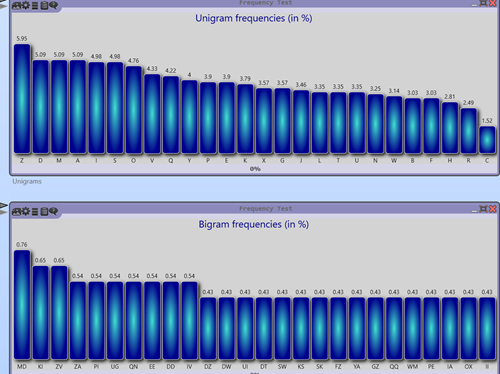
The distribution is relatively flat. This suggests that no simple substitution cipher was used. A transposition cipher does not seem to fit either. A Vigenère cipher is at least unlikely.

I do not know whether Köhler himself encrypted these messages. It is equally possible that the sender of the letter performed the encryption. If so, an Abwehr Enigma may have been used. Perhaps an Enigma expert can determine whether these messages are consistent with encryption by an Enigma machine.

If Köhler himself was the encipherer, however, it seems unlikely that he used an Enigma machine. An Enigma would have been too expensive and too conspicuous. So what else could it have been? Readers of my blog have suggested several possibilities, including:

  • One-time pad: This method was not yet widely used during the Second World War, but it cannot be ruled out.
  • Book cipher: Such ciphers are usually represented with numbers. For example, 12345 might refer to the 45th letter on page 123 of a book. That does not fit the present case.
  • Codebook: Some codebooks contain five-letter code groups. However, in such systems, messages often end with shorter letter groups. Since this is not the case here, it suggests that the encryption was applied letter by letter rather than word by word. A codebook therefore seems unlikely.

Nazi spies used a wide variety of methods. In a talk I gave at the EuroHCC 2017, I listed, among others, the following (there were certainly more):
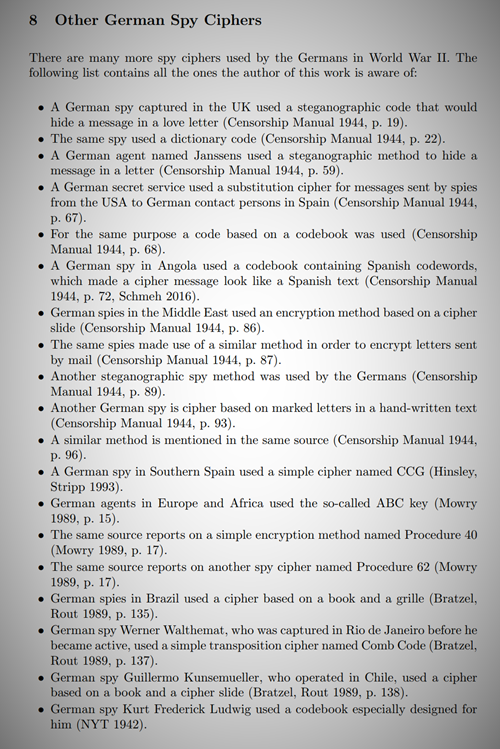
Most of these methods were relatively simple and not particularly secure. Overall, the chances are therefore quite high that the Köhler cryptograms can be broken. The first challenge, however, is to determine which encryption method was used. The steganographic techniques listed above can be ruled out, and book ciphers also seem unlikely.

Any further clues or ideas that might help solve this puzzle are very welcome.

Literature

David Kahn: Hitler’s Spies: German Military Intelligence in World War II. Da Capo Press 2000

Klaus Schmeh: German Spy Ciphers of World War II. EuroHCC 2017

Back to Unsolved Crypto Mysteries

The Furlong postcard

In the early 20th century, encrypted postcards were a common way to communicate secret messages, especially among young couples. With the telephone still not widespread, postcards were a popular means of correspondence, offering a quick way to send messages across distances.

However, not everyone was comfortable with the idea of their private words being read by postmen or curious family members. As a result, many turned to encryption as a way to safeguard their secrets. Though the majority of surviving encrypted postcards are relatively simple to decipher today, one particular postcard has baffled cryptographers and historians for many years.

A postcard sent by football official George Furlong to his sister Lizzie in 1873

The mysterious postcard from George Furlong

This postcard, sent by football official George Furlong from Luton, England, to his sister Lizzie in 1873, has been the subject of numerous decryption attempts—none of which have been successful.

George Furlong

The postcard seems to be written in some form of cipher or a secret script, but it remains unclear whether this was an intentional encryption or simply a rare, obscure form of handwriting. Another question is whether the message is written in English or some other language—perhaps Welsh or French. The handwriting on the card is smooth and fluid, suggesting that the sender was proficient in this particular script. No other examples of writing in this style have been found.

The message on the postcard has never been deciphered.

Analysis

The Furlong postcard is difficult to analyze. The letters are often hard to distinguish reliably, which makes transcription highly challenging. As a result, it is also difficult to carry out a meaningful frequency analysis. At first glance, the double-underlined word in the heading and the single word in the first line appear to be promising cribs. However, attempts to use them so far have not led to any breakthrough.

A particularly puzzling aspect of the postcard is the arrangement of certain letters, which appear stacked or layered on top of one another. What purpose could this serve? Was it simply a stylistic choice, or does it play a role in the encryption? Furthermore, was George Furlong trying to conceal a deeply personal message, or was there another reason behind his unusual writing?

One possibility is that a shorthand system was used. Since there were quite a few shorthand systems in use at the time, it is conceivable that Furlong employed one that is no longer known today. However, the shapes of the letters do not appear to have been designed for rapid writing, which speaks against this interpretation.

Another possible explanation is that the text is written in a phonetic script. In English, it is quite common for a letter or combination of letters to be pronounced differently depending on the word. Consider examples such as “he goes” and “he does,” or “lost” and “host.” In addition, many letter combinations represent a single sound, such as “ph” in “physics” or “gh” in “enough.” Observations like these led various scholars, beginning in the 18th century, to develop phonetic writing systems for English. In such systems, each sound is represented by exactly one symbol. This simplifies spelling, allows pronunciation to be inferred directly from the written form, and often results in shorter words.

Perhaps the best-known phonetic script is the Deseret alphabet, developed in the mid-19th century by Mormons in Utah. Another example is Visible Speech (1867). The well-known Pitman shorthand is also strictly phonetic. Additional phonetic scripts, such as Quikscript and the Unifon alphabet, were developed in the 20th century.

Could the Furlong postcard have been written using a 19th-century phonetic script? The size of the alphabet would be consistent with such a system. The key question, however, is whether a phonetic script existed at the time that matches the characteristics of the Furlong postcard. At present, I am not aware of any such system. Perhaps a reader may be able to provide further insight.

Literature

Klaus Schmeh: Was the Furlong postcard written with a phonetic alphabet?

Klaus Schmeh: Codeknacker gegen Codemacher. Springer 2022

Back to Unsolved Crypto Mysteries