Pollaky’s encrypted newspaper ads
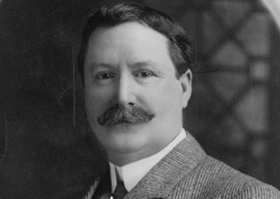
Ignatius Pollaky (1828-1918) was one of the best-known private investigators of his era. Born in Bratislava and later active in London, he built a formidable reputation as a detective and is sometimes described as a real-life inspiration for Sherlock Holmes. Like Arthur Conan Doyle’s fictional investigator, Pollaky appears to have possessed an interest in secret writing and ciphers.
The encrypted ads
The cryptograms surfaced in newspaper advertisements, a common communication channel in the nineteenth century. At the time, newspapers often contained coded personal messages, business arrangements, and covert communications hidden in plain sight. Pollaky placed several such advertisements, some of which were encrypted. Researchers have identified at least a dozen advertisements linked to him, including multiple unsolved cryptograms.
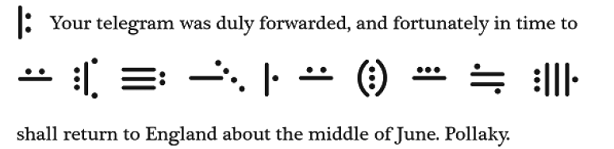
Four of the Pollaky cryptograms have attracted particular attention. One, published in May 1865, appears to use a mysterious secret script rather than an ordinary substitution cipher.
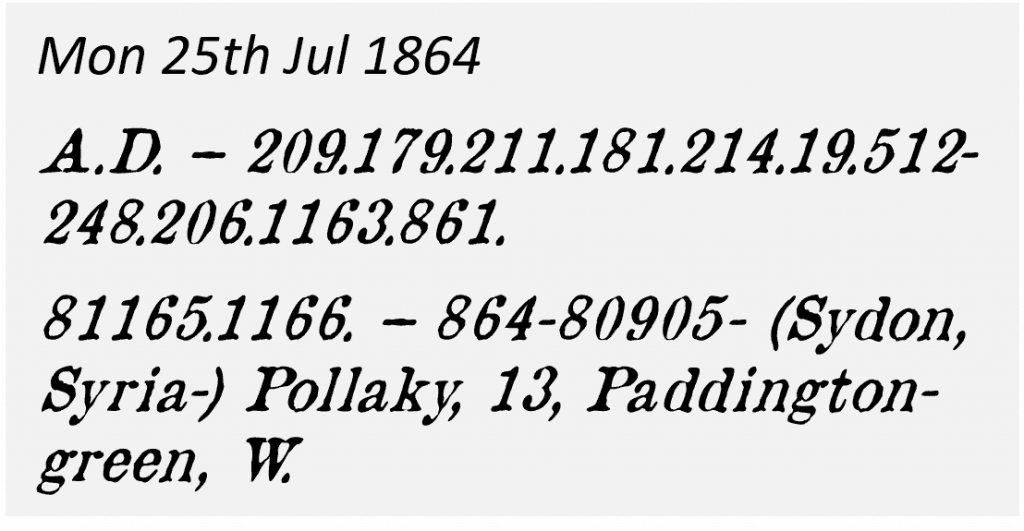
Three additional encrypted advertisements from May 1875 use yet other formats.
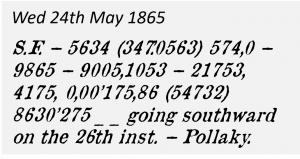
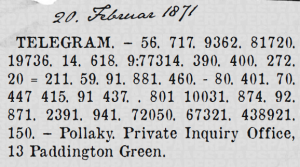
Here’s another ad published by Pollaky:
Analysis of the first cryptogram
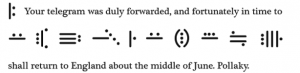
The first Pollaky cryptogram is the strangest. It consists of only eleven symbols, with just one repetition. This makes traditional cryptanalytic methods almost useless. Frequency analysis and probable word search cannot be applied to such a short text. Unless additional ciphertext emerges or someone recognizes the symbols themselves, solving this message may remain impossible.
Equally curious is the choice of symbols in a newspaper advertisement. In a medium where advertisers paid for space, using unusual characters instead of ordinary letters or numbers would likely have been more expensive and certainly less practical. A message written with letters or digits would have been easier to compose and reproduce.
The symbols are quite complex in structure, which suggests that they stem from a large alphabet. My guess is that there are several hundred of these characters, and that each one forms a code group in a code book or nomenclature.
Eight of the ten symbols are axis-symmetric, one is point-symmetric. The remaining one has a regular structure, too. This limits the number of symbols that can be constructed this way. For instance, the following symbols don’t fit into this alphabet:

To my regret, I have never seen an alphabet of this kind somewhere else.
Analysis of the three number cryptograms
The three encrypted ads based on numbers may have been enciphered with the aid of a codebook, in which words or numbers represented prearranged meanings. It might be possible to solve these messages if one finds the codebook used.
Analysis of the last cryptograms
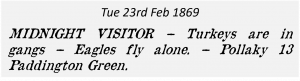
The “MIDNIGHT VISITOR” advertisement is not encrypted in the strict sense. Instead, it was probably a message whose meaning had been agreed upon in advance.
An unsolved mystery
More than 150 years later, the Pollaky cryptograms remain unsolved. Unfortunately, the surviving material offers few clues. According to research by author Bryan Kesselman, Pollaky destroyed his records after retirement, eliminating what might have been the key to understanding his methods. Although hundreds of Pollaky letters survive in archives in Britain and the United States, none appears to reveal the principles behind his cryptographic systems.
Literature
Klaus Schmeh, Elonka Dunin: Codebreaking: A Practical Guide. No Starch Press 2023
Back to Unsolved Crypto Mysteries