The Rabinowitz murder case

For many true-crime enthusiasts, the TV series Forensic Files is considered essential viewing. Among its most talked-about episodes is “Summer Obsession”, which examines the 1997 murder of young U.S. attorney Stefanie Rabinowitz. The investigation identified her husband, Craig Rabinowitz, as the perpetrator.

Craig and Stefanie Rabinowitz — Source: Ai-generated

Part of the case’s notoriety likely stemmed from the involvement of a stripper in the investigation. For us, however, the case is interesting for another reason: it highlights the role of racketeering records analysis in forensic investigation.

Click here to display content from YouTube.
Learn more in YouTube’s privacy policy.

Stefanie Rabinowitz appeared, at first glance, to have lost consciousness in the bathtub and drowned. However, the coroner became suspicious, and a pathologist later confirmed that Stefanie Rabinowitz had in fact been strangled. Only one suspect emerged: her husband, Craig Rabinowitz. He was arrested on the day of the funeral, as the evidence against him was overwhelming. Yet, the motive initially remained unclear.

At first glance, Craig Rabinowitz appeared to be a successful and affluent businessman. However, investigators discovered that his financial success was built on a fraudulent Ponzi-style scheme rather than legitimate business activities. During the investigation, it was revealed that Craig Rabinowitz was also involved in an extramarital affair with a stripper known as “Summer.”

As shown in the Forensic Files episode (starting around 10:25), law enforcement officers conducting a search of his residence uncovered detailed racketeering records (referred to as “ledger”) documenting his illegal financial operations. The forensic accounting specialist, Ricardo Zayas was commissioned to analyze these documents and help interpret the extent of the fraudulent activity.

Rabinowitz’s notes were divided into two columns: “Out” on the left and “In” on the right. The Out column detailed his debts, while the In column outlined the financial gains he stood to receive in the event of his wife’s death. In the Out column, entries listed a fixed amount—representing an investor’s contribution—alongside a percentage rate, apparently referring to interest. Rabinowitz had also used abbreviations to identify investors. “RAB” appeared to refer to his mother, while “J.S.” stood for his friend Jeffrey Solomon. Another recurring notation, “6600/MO,” indicated monthly payments of 6,600 U.S. dollars.
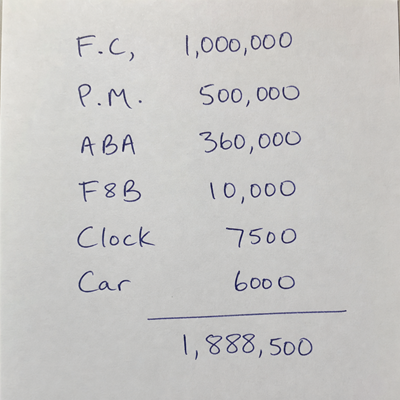
In the event of his wife’s death, Rabinowitz stood to receive $1,885,500 — Source: Ai-generated

In the television documentary mentioned, a section of the ledger is shown. It displays the In column. The image above (AI-generated) presents the content in greater clarity. The content reads:

F.C., 1,000,000
P.M. 500,000
ABA 360,000
F&B 10,000
Clock 7500
Car 6000
——-
1,885,500

Using Ken Englade’s book Everybody’s Best Friend, the note can be interpreted as follows: in the event of his wife’s death, Rabinowitz calculated that he would receive:

  • $1,000,000 from a life insurance policy with First Colony (F.C.)
  • $500,000 from a life insurance policy with Provident Mutual (P.M.)
  • $360,000 from a life insurance policy with New York Life, taken out through the American Bar Association (ABA), a U.S. professional organization for lawyers
  • $10,000 from a life insurance policy provided by Stefanie’s employer, Fineman & Bach (F&B)
  • $7,500 for a watch
  • $6,000 for Stefanie’s car

This means that, in the event of his wife’s death, Rabinowitz stood to receive $1,885,500. As early as the day after the murder, he pawned his wife’s jewelry at a pawn shop and received an additional sum of money that does not even appear to have been included in the calculation.

Ricardo Zayas’s report on his examination of the ledger was 70 pages long. Investigators concluded from it that Craig Rabinowitz’s motive was financial gain: by orchestrating his wife’s murder, he intended to collect the insurance payout, satisfy his investors, and retain remaining funds for himself and his lover.

The ledger was the only one piece of physical evidence tying Rabinowitz to his wife’s murder. It represented, in Rabinowitz’s own hand-writing, his motive for wanting to kill his wife. Craig Rabinowitz was ultimately convicted of murder and sentenced to life imprisonment without the possibility of parole.

Literature

Ken Englade: Everybody’s Best Friend. The shocking murder that exposed a devoted husband as a cold-hearted killer. St. Martin’s Press. 1999

Rebecca Reisner: Craig Rabinowitz’s Gratuitous Crime. Forensic Files Now. 2016

Back to Ciphers and Crime

Racketeering documents published by the CRRU

When dealing with criminal cases involving traditional encryption, sooner or later you’ll come across the CRRU, the FBI’s code-breaking unit. It has cracked quite a few tricky encryption schemes used by murderers, robbers, spies, and organized criminals. Unfortunately, the CRRU isn’t particularly forthcoming, which is why so little is known about its work.

The abbreviation CRRU stands for “Cryptanalysis and Racketeering Records Unit.” Most readers of this blog probably know what “cryptanalysis” means: it refers to the process of breaking codes. The term “racketeering record,” on the other hand, is less common. “Racketeering” is a collective term for illegal activities of all kinds – from drug trafficking and handling stolen goods to extortion. In this context, “record” does not refer to a personal best, but rather to a record or document. The “Cryptanalysis and Racketeering Records Unit” is thus a unit that deals with deciphering encrypted messages and analyzing records from illegal activities.

The starting point is that drug dealers, protection racketeers, pimps, loan sharks, operators of illegal gambling rings, and similar individuals must keep records of their business – unless they want to lose track of things. But it’s also clear that criminals don’t adhere to any accounting standards in this regard. On the contrary: they will try to design their documents so that an outsider cannot understand them.

Of course, a crook can use a computer and an encryption program for his racketeering records. We’ll set that aside for now. With handwritten records, an illegal businessman can employ various tricks:

  • He omits meaningful explanations, headings, and comments. In computer science, this would be called obfuscation.
  • He disguises the document as a phone list, restaurant bill, or something similar. This is a form of steganography.
  • He uses code words, replaces letters with symbols, scrambles numbers, or employs similar tricks. This is a form of cryptography.

It is clear that racketeering records play an important role for the police. That is why there are specialists – certainly not just at the CRRU – who analyze them.

While much has already been published about encrypted messages, very little can be found on racketeering records. A Google search for the term yields hardly any useful results.

Three examples from the CRRU website

After all, a few years ago I found three examples of racketeering records on the CRRU’s website at the time. The first one refers to a drug deal and is written on a restaurant notepad as a cover:

Source: FBI

The following note is an illegal betting slip, which is almost impossible for an outsider to recognize:

Source: FBI

And here is an illegal loan agreement, written on a form that was presumably printed for a jeweler:

Source: FBI

More CRRU examples

There are a few additional examples published by the CRRU in brochures or articles. In all cases, the subject is drug trafficking. Code words such as “NIEVE” or “VENTANA” are used, presumably referring to drugs:

Source: Analysis of Drug Trafficking Ledgers

Terms such as “grasa” and “Barrada” are also presumably code words referring to drugs:

Source: CRRU brochure

A Marijuana Bale List:

Source: Analysis of Drug Trafficking Ledgers

This example concerns drugs for which the weight is specified:

Source: Analysis of Drug Trafficking Ledgers

Das folgende ist eine Berechnung (23,000 – 9,000 = 14,000     – 13,000 = 1,000):

Source: Analysis of Drug Trafficking Ledgers

Ich wünschte, die CRRU würde mehr zu diesem Thema veröffentlichen, aber das tut sie nicht. Racketeering Records Analysis ist daher nach wie vor zu großen Teilen eine Geheimwissenschaft.

Literature

Analysis of Drug Trafficking Ledgers

CRRU brochure

Back to Ciphers and Crime