For many true-crime enthusiasts, the TV series Forensic Files is considered essential viewing. Among its most talked-about episodes is “Summer Obsession”, which examines the 1997 murder of young U.S. attorney Stefanie Rabinowitz. The investigation identified her husband, Craig Rabinowitz, as the perpetrator.

Craig and Stefanie Rabinowitz — Source: Ai-generated
Part of the case’s notoriety likely stemmed from the involvement of a stripper in the investigation. For us, however, the case is interesting for another reason: it highlights the role of racketeering records analysis in forensic investigation.
Stefanie Rabinowitz appeared, at first glance, to have lost consciousness in the bathtub and drowned. However, the coroner became suspicious, and a pathologist later confirmed that Stefanie Rabinowitz had in fact been strangled. Only one suspect emerged: her husband, Craig Rabinowitz. He was arrested on the day of the funeral, as the evidence against him was overwhelming. Yet, the motive initially remained unclear.
At first glance, Craig Rabinowitz appeared to be a successful and affluent businessman. However, investigators discovered that his financial success was built on a fraudulent Ponzi-style scheme rather than legitimate business activities. During the investigation, it was revealed that Craig Rabinowitz was also involved in an extramarital affair with a stripper known as “Summer.”
As shown in the Forensic Files episode (starting around 10:25), law enforcement officers conducting a search of his residence uncovered detailed racketeering records (referred to as “ledger”) documenting his illegal financial operations. The forensic accounting specialist, Ricardo Zayas was commissioned to analyze these documents and help interpret the extent of the fraudulent activity.
Rabinowitz’s notes were divided into two columns: “Out” on the left and “In” on the right. The Out column detailed his debts, while the In column outlined the financial gains he stood to receive in the event of his wife’s death. In the Out column, entries listed a fixed amount—representing an investor’s contribution—alongside a percentage rate, apparently referring to interest. Rabinowitz had also used abbreviations to identify investors. “RAB” appeared to refer to his mother, while “J.S.” stood for his friend Jeffrey Solomon. Another recurring notation, “6600/MO,” indicated monthly payments of 6,600 U.S. dollars.
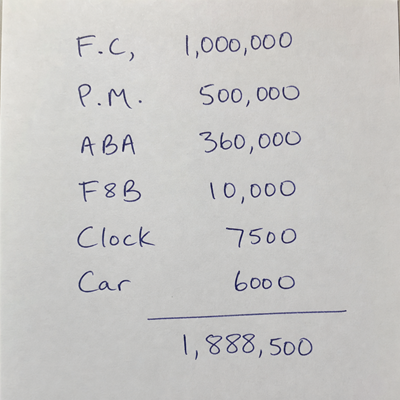
In the event of his wife’s death, Rabinowitz stood to receive $1,885,500 — Source: Ai-generated
In the television documentary mentioned, a section of the ledger is shown. It displays the In column. The image above (AI-generated) presents the content in greater clarity. The content reads:
F.C., 1,000,000
P.M. 500,000
ABA 360,000
F&B 10,000
Clock 7500
Car 6000
——-
1,885,500
The ledger was the only one piece of physical evidence tying Rabinowitz to his wife’s murder. It represented, in Rabinowitz’s own hand-writing, his motive for wanting to kill his wife. Craig Rabinowitz was ultimately convicted of murder and sentenced to life imprisonment without the possibility of parole.
Literature