The Ohio cryptogram
On June 27, 1916, a man robbed the ticket counter of the Western Ohio Railway in Lima, Ohio. Brandishing a gun, he forced the ticket agent to hand over the contents of the safe, then fled with $265.
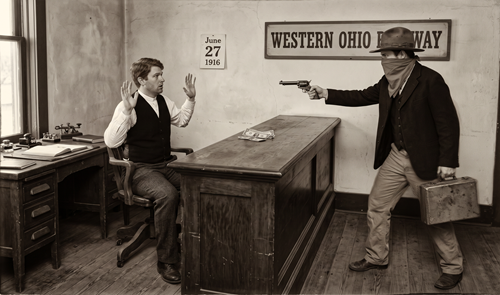
This ticket-counter robber left behind an encrypted message — Source: AI-generated
A few weeks later, the magazine Enigma, published by the National Puzzlers’ League, wrote:
The police department of Lima, O., is greatly puzzled over a cryptic message received in connection with the robbery of a Western Ohio ticket agent. Here it is: WAS NVKVAFT BY AAKAT TXPXSCK UPBK TXPHN OHAY YBTX CPT MXHG WAE SXFP ZAVFZ ACK THERE FIRST TXLK WEEK WAYX ZA WITH THX.
An encrypted message
This cipher and its accompanying true-crime story were uncovered by Dave Oranchak – one of the cryptanalysts behind the solution of a second Zodiac Killer case message – and later brought to wider attention by Nick Pelling on his Cipher Mysteries blog.
Nick identified two contemporaneous reports on the cryptogram in archived issues of the Lima Times Democrat. The ciphertext version printed there differs slightly from the one later published by the National Puzzlers’ League. Since the Enigma author likely relied on the newspaper account, the Lima Times Democrat version is the most reliable basis for analysis. Here it is:
Was nvlvaft by aakat txpxsck upbk txphn ohay ybtx cpt mxhg wae sxfp zavfz ack there first txlk week wayx za with thx
The Lima Times Democrat even published a solution of the cryptogram:

This solution of the Ohio cryptogram doesn’t make sense — Source: Lima Times Democrat
However, it is immediately clear that this solution is wrong. It is extremely unlikely that a monoalphabetic substitution cipher (MASC) produces half a dozen meaningful words (THERE, FIRST, WEEK, ….) within one or two encrypted sentences. Even if one applies the table only to the cryptic-looking words, no readable cleartext appears.
A bandit’s telegram?
It is not known to me what exactly the relationship between the cryptogram and the robbery is. The most likely explanation is that this message is a telegram. Telegraphy was quite popular in 1916, and encrypting a telegram was nothing unusual. Usually, a codebook was used for this purpose. In fact, the train station robbery cryptogram looks exactly like a codebook-encrypted message. The sender left a few less important words (WAS, BY, FIRST, THX, …) in the clear, while he looked up the others in a codebook.
If the train station robbery cryptogram really is a telegram it seems possible that the robber sent it immediately before or after the act. Perhaps, the telegraphy clerk informed the police after having realized that he had dealt with a criminal.
Here’s an example of a codebook page (alas, it’s not the one that was used for the train station robbery cryptogram):
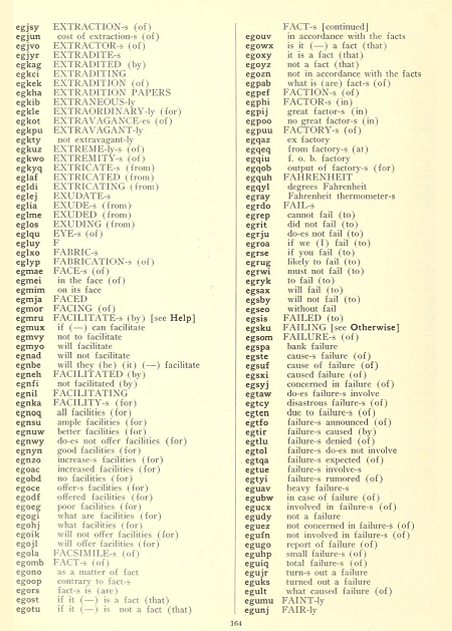
Page of a codebook
Codebooks were not only used for encryption but also for shortening messages (as you see on the example page above, a codeword like EGEUZ may stand for a longer expression, like “not concerned in failure-s (of)”). For this reason, many codebooks were public and underwent no major changes for many years. If somebody wanted to use a public codebook for encryption, he often applied an additional cipher, for instance by adding the current date to every codeword used.
If the train station robbery cryptogram is actually codebook-encrypted I’m afraid, it can only be solved if somebody finds the codebook that was used.
Of course, it is not absolutely granted that the train station robbery cryptogram was encrypted with a codebook. Other encryption techniques used in the time of the First World War are possible, too.
In any case, solving this crypto mystery might shed some additional light on an unsolved crime, which happened over a century ago.
Literature
Klaus Schmeh: Codeknacker gegen Codemacher. 2007
John McVey’s codebook page
Satoshi Tomokiyo’s codebook page
Back to Ciphers and Crime