At the risk of repeating myself: autumn 2026 will go down in history. Never before have so many previously unsolved encrypted messages been cracked in such a short period of time.
The reason? Advances in artificial intelligence. AI may not have invented any new codebreaking techniques, but it is making extremely effective use of methods that have been known for decades. And that’s not all. AI can also search archives for encrypted messages, transcribe them, and research their historical background with remarkable success.
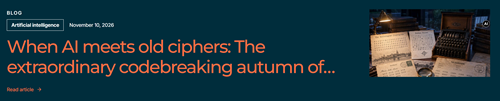
If you’d like to learn more about this topic, take a look at my article on my employer Eviden’s blog:
US journalist Ashley Stimpson has also written about the subject and quoted me in her article.
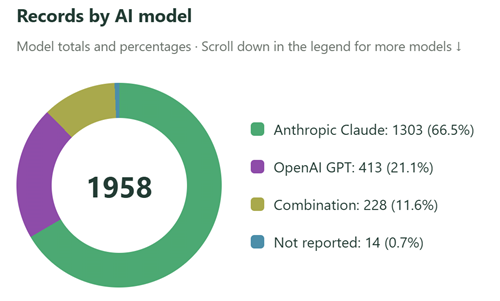
Another highly recommended resource is HCPortal, a website run by Slovakian enthusiast Eugen Antal. He has compiled a list of encrypted messages that have been solved with the assistance of AI. The list currently contains almost 2,000 entries.
I am also preparing a more comprehensive article on recent developments, which is scheduled to appear in a leading computer magazine. I can already reveal one thing: I will be introducing the term “Cryptocalypse” to describe the events of recent weeks.
A bottleneck
There is, however, still one major bottleneck: many archival collections have not yet been digitized. And even among those that have been digitized, not all are available online. Of those that are online, many are still far from being accessible in a way that would allow AI to make the most of them.
The latter problem is particularly evident when it comes to search functionality. Many archives allow users to search for specific words or phrases, but that is simply not sufficient when dealing with encrypted texts. What we really need is the ability to search for characteristics typical of encrypted messages – for example, unusual or rare letter combinations.
Changes
Meanwhile, it is becoming increasingly clear that the world of codebreaking is undergoing some significant changes. For instance, I am very curious about the next HistoCrypt conference. The organizers are evidently expecting a flood of submissions dealing with newly solved ciphers. Interestingly, AI can not only discover and decipher encrypted messages; it can also write academic papers and create PowerPoint presentations. I suspect many people will take advantage of these capabilities.
The organizers have therefore included the following rules in their Call for Papers:
- AI-assisted cipher solutions must be submitted directly through the dedicated HistoCrypt cipher solution portal.
- Artificial Intelligence systems cannot be listed as authors or solvers.
- Human authors and solvers remain fully responsible for their submissions.
- Manuscripts generated wholly or substantially by Artificial Intelligence without a demonstrable human scholarly contribution will be rejected.
The MysteryTwister cipher challenge platform has also had to respond. Apparently, after receiving a substantial number of AI-generated solutions, it has now split its leaderboard into two separate categories: humans and LLMs.
Blog reader Benoît Desnos has brought a new cipher challenge website to my attention: LODESTAR, which he created himself. According to Benoît, the 30 challenges featured on the site have been specifically designed to be solved with the help of AI.
So, the Cryptocalypse is already changing quite a few things. And I have a feeling we’ve only seen the beginning.
I’m very curious to see what happens next.
Back to Cipherbrain Blog