Right now, one cryptanalytic breakthrough is following another. The autumn of 2026 will undoubtedly go down in the history of cryptology. Thanks to AI-assisted methods, cryptographic cold cases that have resisted solution for decades are suddenly being cracked one after another.
The Kaliningrad cryptogram
A few days ago, I was contacted by Anton Zaytsev. Originally from Russia and now based in Dubai, Anton works in engineering and digital automation. In his spare time, he enjoys programming and solving challenging puzzles. He is not a cryptologist, but his curiosity was piqued when he came across an unsolved cipher on my Top 50 list. He decided to have a go at it himself.
The mystery that caught Anton’s attention was the Kaliningrad cryptogram. I first encountered this encrypted text in 2015 while searching Russian websites for cryptographic stories and other topics suitable for my blog. Assisted by Google Translate, I discovered an article in a regional Kaliningrad newspaper describing an encrypted message in a bottle.
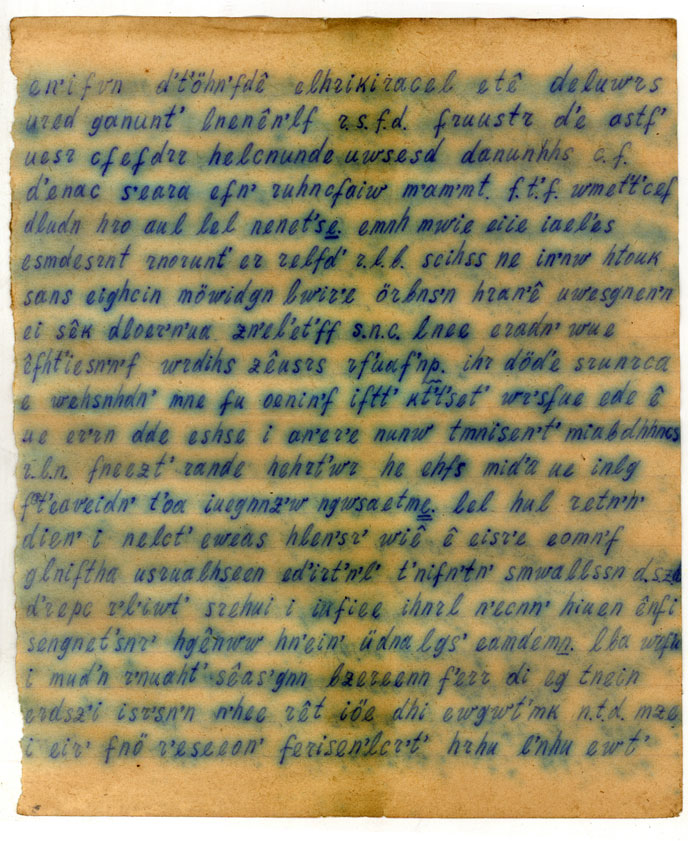
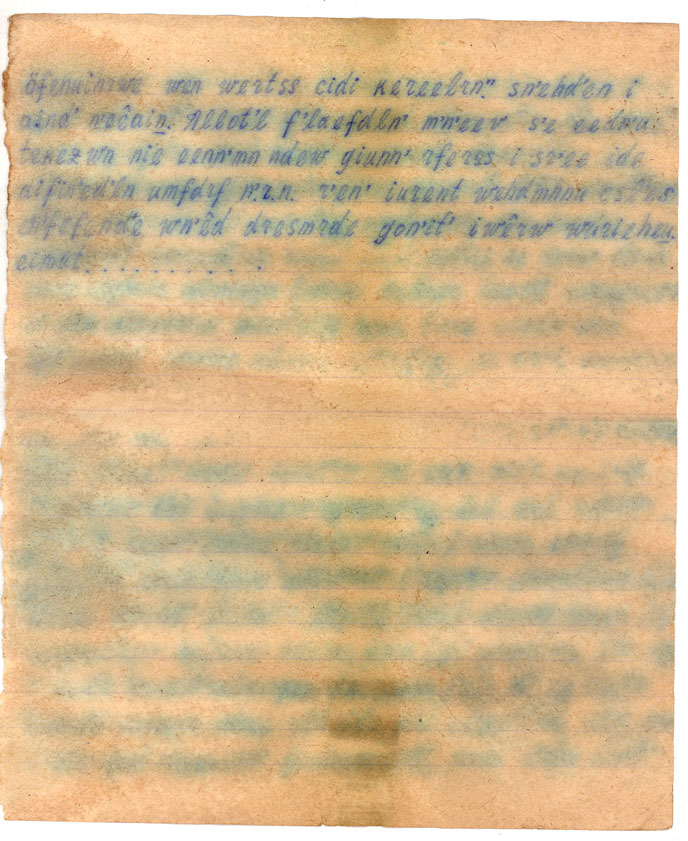
Kaliningrad, formerly Königsberg, was once German territory before becoming part of the Soviet Union after the Second World War. There is already one famous mystery associated with Kaliningrad/Königsberg: the Amber Room. This legendary chamber, made of amber and other precious materials, disappeared during the war and has been sought by treasure hunters ever since. In a sense, the Kaliningrad cryptogram became Kaliningrad’s second great mystery. Later, I learned that the bottle had actually been discovered not in Kaliningrad itself but in nearby Baltiysk (formerly Pillau). Nevertheless, the name “Kaliningrad cryptogram” had already become established, and I kept using it.
Incidentally, the bottle was not found in water. It was unearthed in front of an apartment block at Lenin Street 64-66 in Baltiysk. Workers digging a trench for a gas pipeline discovered it. The brown bottle itself was a common mass-produced item from the Soviet era. The purpose of the message was unknown.
After presenting the Kaliningrad Cryptogram on my blog, numerous readers examined it. Thomas Bosbach observed that the letter frequencies matched those of a German text surprisingly well. This suggested a transposition cipher, a type of encryption that rearranges the order of letters while leaving their frequencies unchanged. Alex Ulyanenkov, a native Russian speaker, also suspected that the underlying plaintext was German. Thomas Ernst created a transcription of the text and contributed several additional observations. Despite these valuable insights, however, nobody managed to find the solution.
Anton’s solution
Anton finally succeeded with the help of artificial intelligence (check here for a detailed report). He used Claude for coding and experimentation, but did not simply accept the AI’s outputs at face value. Instead, he continuously verified the results and steered the investigation in new directions whenever progress stalled.
The breakthrough came when Anton instructed the AI to compare the letter frequencies of the Kaliningrad Cryptogram with those of known texts. Among millions of candidates, one stood out immediately: the lyrics of the Einheitslied (“Freundschaft! Allen Völkern Freundschaft”), a song from the former East Germany that was especially popular within the FDJ youth organization. Both the overall text length and the individual letter frequencies closely matched those of the ciphertext. It soon became clear that someone had encrypted the Einheitslied using a transposition cipher.
The AI also provided strong clues about how the encryption had been performed. The plaintext appears to have been divided into six consecutive sections, each consisting of roughly 169 characters (i.e. a 13×13 square). Within each section, the order of the letters was rearranged before the resulting ciphertext was written down. Unfortunately, it is still unclear whether a systematic transposition procedure was used and whether a key was involved.
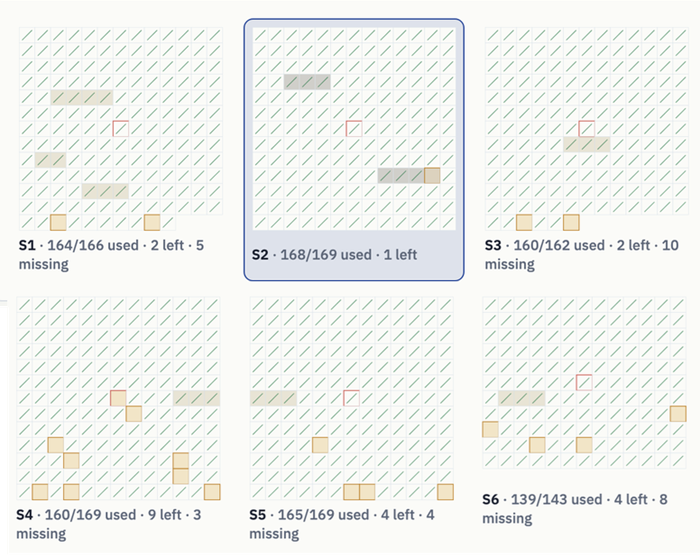 Source: Anton Zaytsev
After the letters had been permuted, they were copied out and separated by seemingly arbitrary spaces. The final fragment ends with the sequence “eimat”, which is the ending of the German word Heimat (“homeland”). Other features match the underlying plaintext remarkably well: apostrophes often correspond to the final letters of words, with t′ frequently appearing where words such as Freundschaft, Einheit, or Welt end. Likewise, the character ê appears to correspond to a word-final e.
Congratulations, Anton! This is a remarkable work.
Open questions
Although Anton has solved the main mystery now, several important questions remain:
- What was the purpose of this bottle message? When exactly was it created? Why would somebody encrypt the lyrics of a German song that was neither secret nor forbidden?
- Was there a specific transposition method used to rearrange the letters? If so, did it involve a key?
- As can be read in Anton’s treatise, dotted letter groups appear near the center of each block of text, such as r.s.f.d., c.f., f.t′.f., r.l.b., and s.n.c. What do they mean?
The Kaliningrad Cryptogram may no longer be unsolved, but it still has a story to tell. And perhaps, somewhere in that story, another mystery is waiting to be uncovered.
Back to Cipherbrain Blog