It is incredible. Yet another Top-50 crypto puzzle has been cracked with the help of AI.
As I have mentioned several times, autumn 2026 will go down in the history of codebreaking. Never before have so many significant unsolved ciphers been solved in such a short period of time. Of course, there is a reason for this: AI is currently overtaking humans when it comes to codebreaking. I am sure AI will celebrate many more codebreaking successes in the future. But I suspect that we will never again experience a period in which so many famous unsolved ciphers – some of them known for decades – are solved within such a short time.
The puzzle I am writing about today is the encrypted message of T. E. Wood. I have mentioned it in several of my books, blogged about it several times, written articles about it, and given talks about it. For example, in 2013 I wrote a German-language article about it for Telepolis.
Cryptograms from the Crypt
But let’s start at the beginning. In 1948, British parapsychologist Robert Thouless launched an unusual experiment. The idea was simple, at least in theory. Thouless encrypted a message in a way that he believed was impossible to break. He then announced that, after his death, he would attempt to communicate the key from beyond the grave. If this worked – if Thouless could somehow transmit the key after his death and the key could then be used to decrypt the message – it would constitute evidence that life after death exists and that the dead can communicate with the living. One of the greatest sensations in the history of science would be complete.
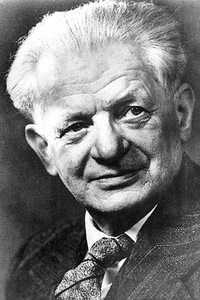
The encrypted message Thouless published for this purpose later became known as Message A. To guard against something going wrong, he also published a second encrypted message, later called Message B. He intended to communicate the key to this one after his death as well. Apparently, he was confident that he would be able to remember two secret words beyond the grave.
Only a few weeks after the publication, a cryptologist came forward and solved Message A – without any supernatural assistance whatsoever. Thouless therefore decided to encrypt another message. Message C, as it is now known, was published in 1949. Messages B and C remained unsolved until Thouless died in 1984.
In the months following his death, the Society for Psychical Research received around 100 suggestions for the secret words. None was correct.
In 1996, codebreakers James Gillogly and Larry Harnisch published the solution to Message C under the wonderfully appropriate title Cryptograms from the Crypt. They had not received the key from the afterlife. Instead, they had used hill-climbing algorithms.
Finally, in 2019, Australian codebreaker Richard Bean solved Message B – again without assistance from beyond the grave. All three Thouless messages had now been solved. The dead, however, had remained silent.
Wood’s Experiment
As early as 1948, Robert Thouless had encouraged other people to conduct experiments along the same lines. As far as I know, initially only one person took up the challenge: T. E. Wood, a solicitor from Bournemouth, England. Wood’s text was encrypted using the same method as Thouless’s Message B. He used a key phrase in which each word enciphered one letter of the plaintext.
Wood stated that the key text came from a generally available book that was not written in English. He also claimed that the plaintext was written in several languages – which is quite a promise for a message of only 21 letters. Here is the ciphertext:
FVAMI NTKFX XWATB OIZVV X
This morning I received an email from Colin Reilly. He claimed to have solved the Wood message. I was skeptical. I receive quite a few emails of this kind, and most of them turn out to be wrong. On the other hand, as I mentioned above, we have witnessed some spectacular codebreaking successes in recent weeks. Perhaps the series would continue. And indeed it did. Colin was right.
The Solution
Wood had stated that he had used a sentence from a generally available book as his key. With the assistance of AI, Colin therefore created a computer program that searched through books that would have been available around 1948, looking for a sentence that would produce a meaningful result. This was, in other words, a classic needle-in-a-haystack problem. The needle was found.
The key turned out to be the Lord’s Prayer in German, in the wording of the 1912 Luther Bible, Matthew 6:9–11. Here are the corresponding words. Repeated words are skipped, as specified by Wood:
UNSER VATER IN DEM HIMMEL DEIN NAME WERDE GEHEILIGT REICH KOMME WILLE GESCHEHE AUF ERDEN WIE IM TÄGLICH BROT GIB UNS
According to Wood’s method, each word has to be converted into a number. The letters of each word are converted into numbers (A=1, B=2, etc.) and added together (the umlaut in täglich is treated as an a). If the result is greater than 25, 26 is subtracted.
UNSER: 21+14+19+5+18 = 77 -> 25
VATER: 22+1+20+5+18 = 66 -> 14
IN: 9+14 = 23 -> 23
DEM: 4+5+13 = 22 -> 22
HIMMEL: 8+9+13+13+5+12 = 60 -> 8
DEIN: 4+5+9+14 = 32 -> 6
NAME: 14+1+13+5 = 33 -> 7
WERDE: 23+5+18+4+5 = 55 -> 3
GEHEILIGT:7+5+8+5+9+12+9+7+20 = 82 -> 4
REICH: 18+5+9+3+8 = 43 -> 17
KOMME: 11+15+13+13+5 = 57 -> 5
WILLE: 23+9+12+12+5 = 61 -> 9
GESCHEHE: 7+5+19+3+8+5+8+5 = 60 -> 8
AUF: 1+21+6 = 28 -> 2
ERDEN: 5+18+4+5+14 = 46 -> 20
WIE: 23+9+5 = 37 -> 11
IM: 9+13 = 22 -> 22
TAGLICH: 20+1+7+12+9+3+8 = 60 -> 8
BROT: 2+18+15+20 = 55 -> 3
GIB: 7+9+2 = 18 -> 18
UNS: 21+14+19 = 54 -> 2
This produces a sequence of numbers that can be matched to the letters of the ciphertext:
F  V  A  M  I  N  T  K  F  X  X  W  A  T  B  O  I  Z  V  V  X
25 14 23 22 8  6  7  3  4  17 5  9  8  2  20 11 22 8  3  18 2
The resulting sequence is then processed using Wood’s decryption table:
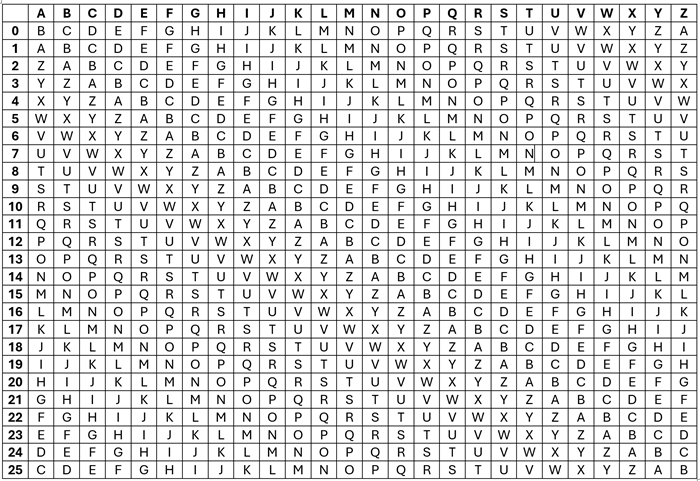
The result is:
HIER BIN ICH TOTSIENS TEW
HIER BIN ICH is German. TOTSIENS is Afrikaans. And TEW are the initials of T. E. Wood. In English, the message says: HERE I AM, SEE YOU, T. E. WOOD.
Wood had therefore delivered exactly what he had promised: a plaintext consisting of several languages. The puzzle is solved. Congratulations, Colin!
A Few Words About Colin Reilly

Colin Reilly is based outside Seattle, Washington, USA, and works as a UX designer for a cybersecurity startup. He had never done any codebreaking before. His adventure began as an experiment to see how far current AI tools could get with my Top 50 list, after he saw some of the solutions that emerged following the release of Fable. He has written up how he found the solution, including the dead ends he encountered along the way.
Open Questions
Does this mean that all puzzles of this type have now been solved? No. I have actually created a message of this kind myself. I have described how I encrypted it and how potential key-text candidates can be tested here. The resulting ciphertext looks like this:
35 12 C7 9E 9B 4D 41 53 60 BC 75 6E B9 25 B2 53
So there is still something for future codebreakers – and future AIs – to work on.
There is another open question. In 1980, Frank Tribbe and Clarissa Mulders, members of the Survival Research Foundation, called on their readers to create cryptograms of the Thouless type and to channel the keys after their deaths. They also asked readers to send the encrypted texts to the Survival Research Foundation for archival purposes. Unfortunately, I do not know how many encrypted messages were actually submitted to the organization. What is clear, however, is that such messages would be extremely interesting to codebreakers today. Apparently, the Survival Research Foundation no longer exists. I also do not know what happened to the cryptograms, assuming that readers of Tribbe and Mulders actually sent any in. If anyone reading this knows more about the fate of these messages, I would be very interested to hear from you.
And there is one more open question. A certain Arthur Berger also conducted an experiment of the Thouless type. Unfortunately, I do not have access to the relevant source, which is: Berger, A. S. (1990). Tests for communication with the dead. In G. Doore (Ed.), What Survives? (pp. 51–60). Tarcher. Does anyone have a copy of this chapter—or know more about Berger’s experiment? If so, please get in touch.
Back to Cipherbrain Blog