Christopher Love (1618–1651) was a Welsh Presbyterian minister and political activist who lived through the turbulent years of the English Civil War. After becoming involved in secret negotiations with the exiled Stuart court, he was convicted of treason and beheaded on Tower Hill in London on 22 August 1651.
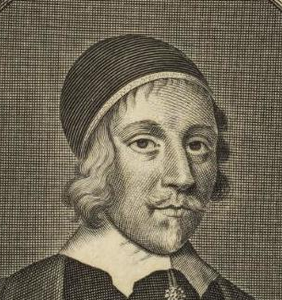
This alone would make Love an interesting historical figure. However, there is another, considerably more mysterious aspect of his legacy: a number of prophecies have been attributed to him.
The prophecies of Christopher Love

My long-time friend and blog reader Karsten Hansky, pictured on the right next to me, recently drew my attention to these predictions. There is even a book about them, titled Prophecies of the Reverend Christopher Love: And His Last Words on the Scaffold.
Whether the predictions really originated with Love is unclear. They may have been written by somebody else and attributed to him after his death, possibly to give them greater authority. Several editions and versions circulated long after 1651. For instance, an American edition published in 1793 announced wars in America in 1780, the destruction of Popery in 1790, and a flourishing of religion in 1795. Another version was printed in Stirling as late as 1806 and and anonymously attributed the predictions to Love..
The writings published under Love’s name mainly deal with the following subjects:
- the fall of “Babylon,” by which the author meant the destruction of the papacy, which Love strongly opposed;
- a worldwide religious revival or Reformation following this event;
- attempts to date future events based on prophecies in the Book of Daniel and the Book of Revelation.
A digitized work titled The Strange and Wonderful Predictions is catalogued under Love’s name with the publication year 1651. However, the existence of later editions and adaptations makes the history and authorship of these texts anything but straightforward.
An encrypted summary
Last year, Karsten acquired an unusual handwritten document titled The Prophecy of Christopher Love. It apparently summarizes Love’s alleged predictions on a single page. Here’s the first of two pages:
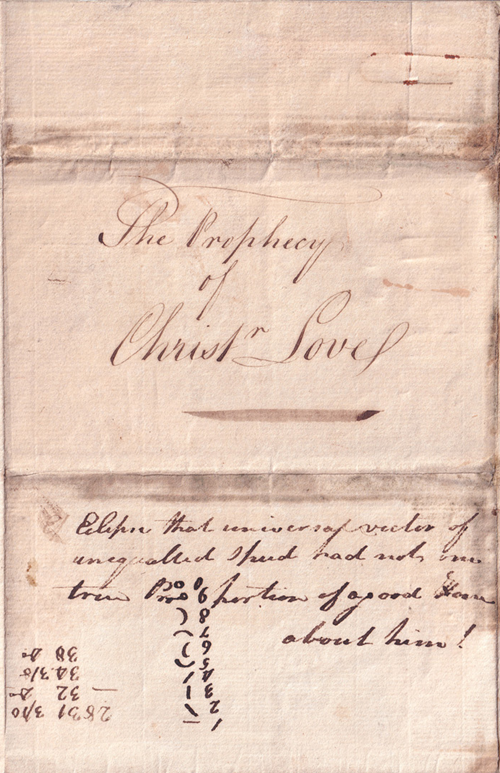
The second page contains the actual text:
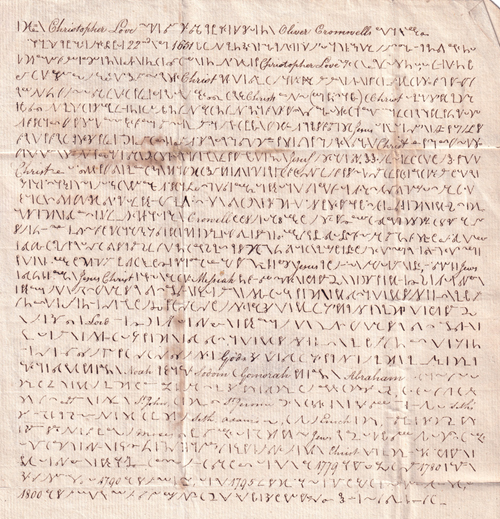
Most of the text is written in an unknown script or cipher. A few words and expressions appear in plaintext. At the end, there are also several striking years. The latest year mentioned in the document is 1800.
The author is unknown, and the document is not dated. Karsten suspects that it was written before 1800. This would certainly make sense: a prophetic chronology ending in 1800 would have been far less interesting once that year had already passed.
A shorthand system?
According to Karsten, an AI analysis suggested that the document might be written in the shorthand system developed by Jeremiah Rich. Rich was the creator of a well-known seventeenth-century English shorthand method, and a religious or prophetic text would not be an implausible application for such a system. Nevertheless, I am sceptical. To my eyes, the writing does not look like typical shorthand. It appears more structured and repetitive, perhaps suggesting a cipher, an artificial alphabet, or a specialized notation system.
Can a reader solve it?
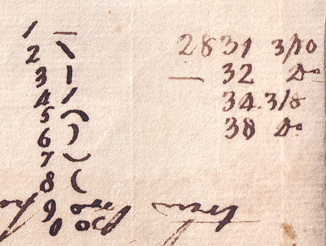
On the title page, a group of numbers and a small table can be seen upside down. Could this be a key, an alphabet, a numerical conversion table, or merely an unrelated calculation? Perhaps it explains how the symbols in the main text are to be read.
Any information about the document, its origin, or its writing system would be greatly appreciated. Perhaps a reader of this blog can solve the mystery of “The Prophecy of Christopher Love.”
Back to Cipherbrain Blog