Blog reader John Haas from Austria has drawn my attention to today’s topic.
John also provided most of the background material for this post. He can be seen on the following picture (right) with me (left) and Christian Baumann (middle).

The cryptogram
According to John, a previously little-known YouTube video has surfaced featuring Pete Townshend, best known as a member of The Who, performing Keep on Working, a song from his 1980 solo album Empty Glass. Judging from the image quality and various visual artifacts, the clip appears to have been created rather spontaneously. It shows Townshend in what seems to be his apartment, where he writes parts of the song lyrics on a chalkboard.
In retrospect, this makes the video an early example of what we now call a lyric video, a format that became enormously popular decades later. One is reminded of Bob Dylan’s famous Subterranean Homesick Blues film clip, in which handwritten cue cards are displayed in front of the camera. Throughout the video, Townshend alternates between playing guitar, enjoying what was reportedly his favorite cognac, Rémy Martin, and affectionately embracing his wife, Karen Astley, who is seated at a table nearby.
One particular sequence deserves special attention. In this post, I will refer to it as the “Townshend cryptogram”. At one point, Townshend writes a strange mixture of symbols on the chalkboard. These include mathematical symbols such as π, astrological signs such as Libra, Greek letters including Alpha and Omega (interestingly in reverse order), and several marks that appear to be entirely invented. After completing this spontaneous creation, he writes the provocative sentence: “Work that out, you t…”
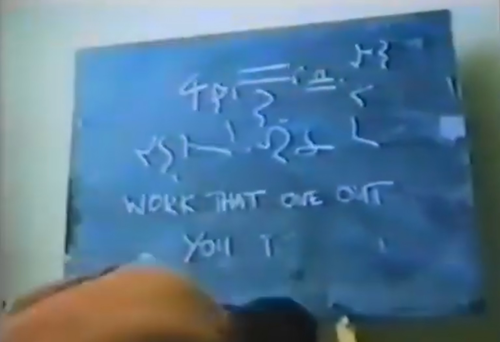
The final word is left unfinished. It may have been intended as “twit” or “twat”, two familiar English insults, but Townshend never completes it, leaving the interpretation to the viewer’s imagination.
The song
According to John, the song itself can be understood on several levels. On the surface, it is a light-hearted reflection on work, earnings, economic necessity, and the fact that some aspects of existence remain outside this cycle. Yet the song can also be interpreted as a playful metaphor for spiritual effort and inner development.
This interpretation becomes more plausible when considering Townshend’s long-standing spiritual interests. Beginning in 1967, he became deeply influenced by the Indian spiritual master Meher Baba and later explored various forms of Eastern mysticism, including Persian Sufism. Central themes of Sufi thought include direct experiences of the divine, the reduction of the ego, and inner purification. Meher Baba himself came from a Zoroastrian background, and Islamic-Persian esoteric traditions include the concept of ʿilm al-ḥurūf, the “science of letters”, a mystical discipline that assigns spiritual significance to characters and symbols.
The word “working” in Townshend’s song may therefore operate on several levels simultaneously. On one level, it simply means continuing, persevering, and pursuing a task. Yet sustained work gradually takes on the character of a philosophy of life. The goal is no longer a specific result but rather the process itself. Through activity, persistence, and concentration, one remains on a chosen path.
This interpretation fits remarkably well with Meher Baba’s teachings, which emphasize selfless action and the overcoming of the ego. Viewed from this perspective, the chalkboard sequence becomes particularly intriguing. At first glance, the seemingly scholarly cryptogram, with its combination of numbers, π, Greek letters, astrological signs, and mysterious symbols, invites viewers to search for hidden meaning. “Work that out” can be understood as an explicit challenge: “Decipher this.”
Is there a solution?
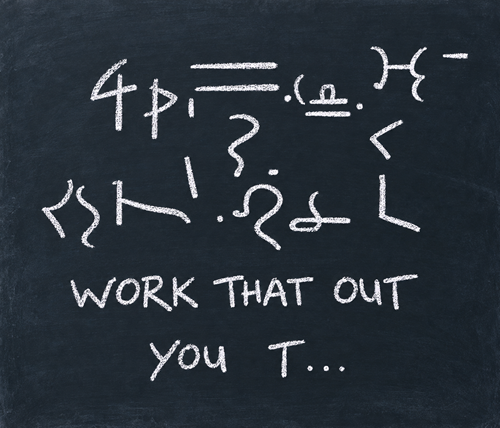
It is well possible that this cryptogram has no meaning. By inviting interpretation, he simultaneously demonstrates the futility of humanity’s endless search for ultimate meaning and secret knowledge. The viewer is encouraged to engage in precisely the kind of intellectual exercise that may ultimately lead nowhere. This would be perfectly consistent with the playful spirit of the song. Keep on Working addresses serious topics with humor and lightness. Known for his wit, Townshend may simply have been poking fun at excessive mystification, at the tendency to read profound significance into every symbol and coincidence. The cryptogram could therefore be less an encrypted message than a glimpse into his associative thinking, his sense of humor, and his personal worldview.
Still, we don’t know. There might be a solution to this ciphertext. If so, can anyone decipher it?
Back to Cipherbrain Blog