Racketeering documents published by the CRRU
When dealing with criminal cases involving traditional encryption, sooner or later you’ll come across the CRRU, the FBI’s code-breaking unit. It has cracked quite a few tricky encryption schemes used by murderers, robbers, spies, and organized criminals. Unfortunately, the CRRU isn’t particularly forthcoming, which is why so little is known about its work.
The abbreviation CRRU stands for “Cryptanalysis and Racketeering Records Unit.” Most readers of this blog probably know what “cryptanalysis” means: it refers to the process of breaking codes. The term “racketeering record,” on the other hand, is less common. “Racketeering” is a collective term for illegal activities of all kinds – from drug trafficking and handling stolen goods to extortion. In this context, “record” does not refer to a personal best, but rather to a record or document. The “Cryptanalysis and Racketeering Records Unit” is thus a unit that deals with deciphering encrypted messages and analyzing records from illegal activities.
The starting point is that drug dealers, protection racketeers, pimps, loan sharks, operators of illegal gambling rings, and similar individuals must keep records of their business – unless they want to lose track of things. But it’s also clear that criminals don’t adhere to any accounting standards in this regard. On the contrary: they will try to design their documents so that an outsider cannot understand them.
Of course, a crook can use a computer and an encryption program for his racketeering records. We’ll set that aside for now. With handwritten records, an illegal businessman can employ various tricks:
- He omits meaningful explanations, headings, and comments. In computer science, this would be called obfuscation.
- He disguises the document as a phone list, restaurant bill, or something similar. This is a form of steganography.
- He uses code words, replaces letters with symbols, scrambles numbers, or employs similar tricks. This is a form of cryptography.
It is clear that racketeering records play an important role for the police. That is why there are specialists – certainly not just at the CRRU – who analyze them.
While much has already been published about encrypted messages, very little can be found on racketeering records. A Google search for the term yields hardly any useful results.
Three examples from the CRRU website
After all, a few years ago I found three examples of racketeering records on the CRRU’s website at the time. The first one refers to a drug deal and is written on a restaurant notepad as a cover:
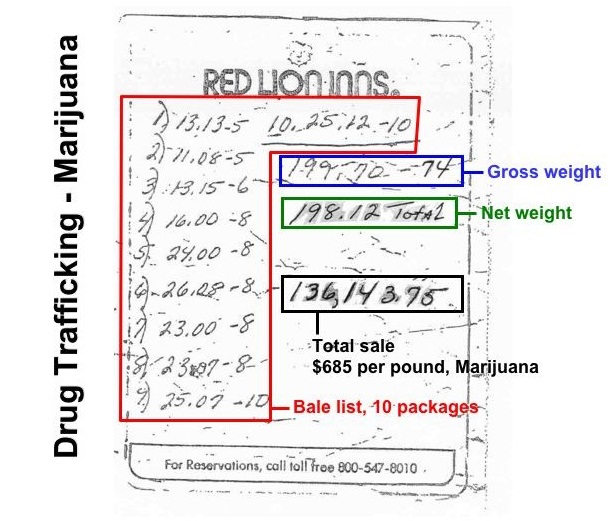
Source: FBI
The following note is an illegal betting slip, which is almost impossible for an outsider to recognize:
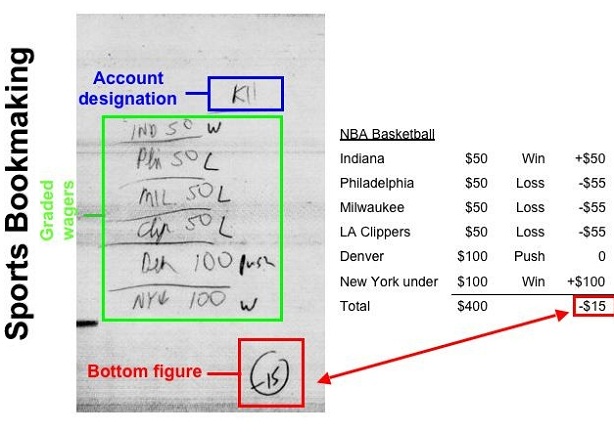
Source: FBI
And here is an illegal loan agreement, written on a form that was presumably printed for a jeweler:
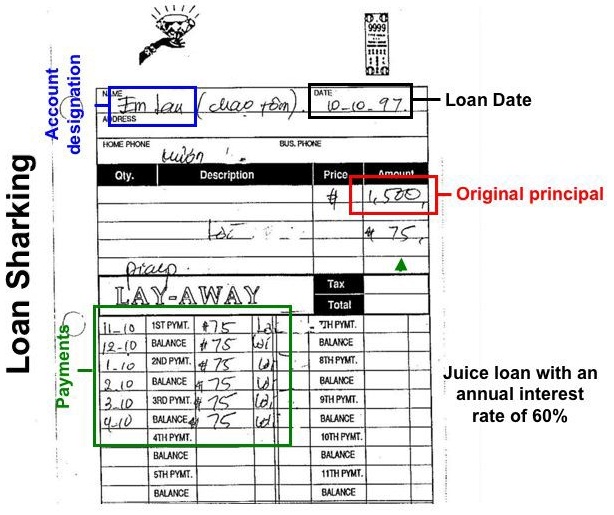
Source: FBI
More CRRU examples
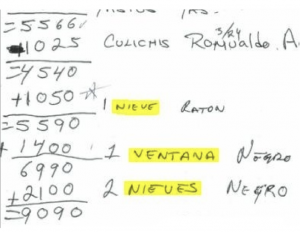
Source: Analysis of Drug Trafficking Ledgers
Terms such as “grasa” and “Barrada” are also presumably code words referring to drugs:
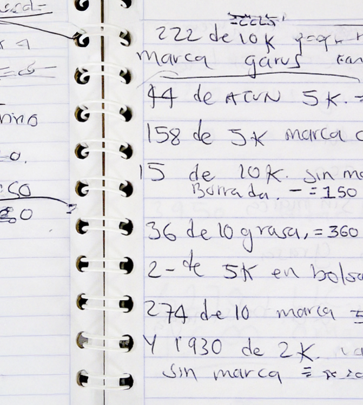
Source: CRRU brochure
A Marijuana Bale List:
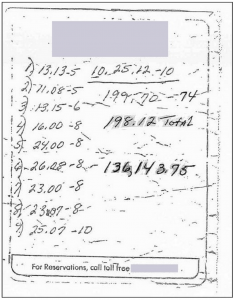
Source: Analysis of Drug Trafficking Ledgers
This example concerns drugs for which the weight is specified:
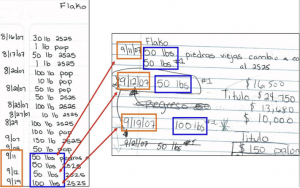
Source: Analysis of Drug Trafficking Ledgers
Das folgende ist eine Berechnung (23,000 – 9,000 = 14,000 – 13,000 = 1,000):

Source: Analysis of Drug Trafficking Ledgers