The cigarette case cryptogram
This unsolved cryptographic puzzle has caused me quite a bit of head-scratching. At first glance, it looks as though it should be easy to decipher — yet no one has managed to solve it so far. The mystery revolves around a cigarette case bearing an engraved inscription.
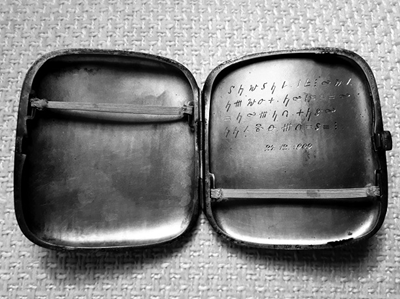
The message
The inscription consists of four encrypted lines. Here’s a closer shot:
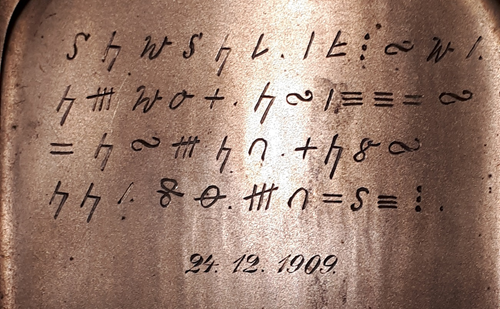
The cryptogram is dated December 24, 1909, suggesting that the cigarette case may have been a Christmas present (In Germany, gifts are traditionally exchanged on December 24 rather than on Christmas Day.). The date seems to show the hand of a professional engraver, while the encrypted message itself looks rather crude.The format of the date (dd.mm.yyyy) is characteristic of German usage. The current owner, who inherited the case from his father – the object having remained in the family for generations – provided the following information:
- There is no reliable information about the origin of the case.
- The family primarily comes from Thuringia, now part of eastern Germany.
- The family has always spoken German.
- A hallmark indicates that the case is made of 800 silver. It features a Reichssilberstempel with a crescent and a crown, the standard silver hallmark used in Germany at the time.
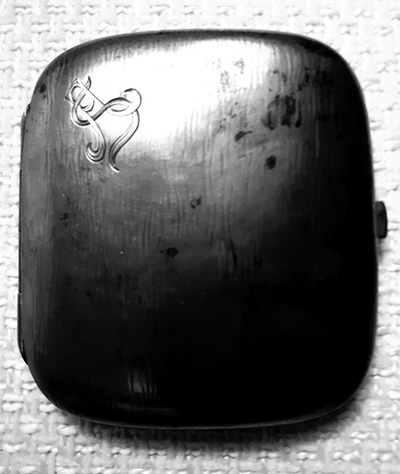
- The symbol on the front of the case depicts the letters “AS,” which are likely the initials of the original owner.
Analysis
To me, this cryptogram initially appeared to be a straightforward monoalphabetic substitution cipher (also known as MASC), a type of one-to-one encryption commonly encountered in encrypted postcards, Freemasonic documents, private diaries, and cryptographic puzzles, to name just a few examples. Cryptograms of this kind can usually be solved using techniques such as word guessing or frequency analysis. Things are probably not quite that simple, however.
Here is a transcription of the cryptogram:
1: s h w s h l . / t | ~ w /.
2: h 4 w o + . h ~ / 3 3 = ~
3: = h ~ 4 h n . + h 8 ~
4: h h /. % 0 . 4 n = s 3 | .
The periods are most likely word separators. Lines 1 and 4 end with a period, which suggests that the final words in lines 2 and 3 continue across the line break. If this assumption is correct, the third-to-last word is not “hh/” but “+h8~hh/”, which seems considerably more plausible.
Frequency analysis and word-guessing techniques have already been tried, but so far without success.
German has many regional dialects, some of which differ considerably from standard German. These differences were even more pronounced a century ago, when travel and communication between regions were less common and neither television nor radio existed. The owner’s family originates from Thuringia, a region with its own dialect: the Thuringian dialect.
After publishing my first blog article about this cryptogram, I received around 40 comments. Blog reader Charlotte von Auer pointed out that a cigarette case of this kind would have been a luxury item affordable only to a wealthy – and therefore likely educated – person. It is therefore worth considering that the four lines may represent a poem or a quotation from literature. If the language is not German, Latin and Greek become particularly interesting candidates.
Perhaps a reader will be able to provide further insight.
Literature
Klaus Schmeh: Codeknacker gegen Codemacher. Springer 2022
Back to Unsolved Crypto Mysteries