The Furlong postcard
In the early 20th century, encrypted postcards were a common way to communicate secret messages, especially among young couples. With the telephone still not widespread, postcards were a popular means of correspondence, offering a quick way to send messages across distances.
However, not everyone was comfortable with the idea of their private words being read by postmen or curious family members. As a result, many turned to encryption as a way to safeguard their secrets. Though the majority of surviving encrypted postcards are relatively simple to decipher today, one particular postcard has baffled cryptographers and historians for many years.
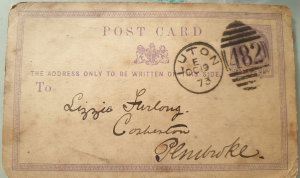
A postcard sent by football official George Furlong to his sister Lizzie in 1873
The mysterious postcard from George Furlong
This postcard, sent by football official George Furlong from Luton, England, to his sister Lizzie in 1873, has been the subject of numerous decryption attempts—none of which have been successful.
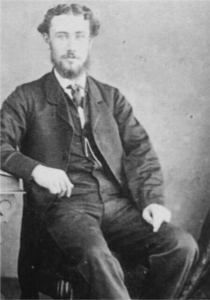
George Furlong
The postcard seems to be written in some form of cipher or a secret script, but it remains unclear whether this was an intentional encryption or simply a rare, obscure form of handwriting. Another question is whether the message is written in English or some other language—perhaps Welsh or French. The handwriting on the card is smooth and fluid, suggesting that the sender was proficient in this particular script. No other examples of writing in this style have been found.
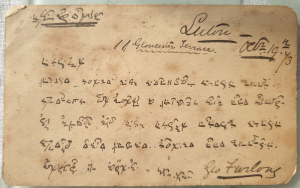
The message on the postcard has never been deciphered.
Analysis
The Furlong postcard is difficult to analyze. The letters are often hard to distinguish reliably, which makes transcription highly challenging. As a result, it is also difficult to carry out a meaningful frequency analysis. At first glance, the double-underlined word in the heading and the single word in the first line appear to be promising cribs. However, attempts to use them so far have not led to any breakthrough.
A particularly puzzling aspect of the postcard is the arrangement of certain letters, which appear stacked or layered on top of one another. What purpose could this serve? Was it simply a stylistic choice, or does it play a role in the encryption? Furthermore, was George Furlong trying to conceal a deeply personal message, or was there another reason behind his unusual writing?
One possibility is that a shorthand system was used. Since there were quite a few shorthand systems in use at the time, it is conceivable that Furlong employed one that is no longer known today. However, the shapes of the letters do not appear to have been designed for rapid writing, which speaks against this interpretation.
Another possible explanation is that the text is written in a phonetic script. In English, it is quite common for a letter or combination of letters to be pronounced differently depending on the word. Consider examples such as “he goes” and “he does,” or “lost” and “host.” In addition, many letter combinations represent a single sound, such as “ph” in “physics” or “gh” in “enough.” Observations like these led various scholars, beginning in the 18th century, to develop phonetic writing systems for English. In such systems, each sound is represented by exactly one symbol. This simplifies spelling, allows pronunciation to be inferred directly from the written form, and often results in shorter words.
Perhaps the best-known phonetic script is the Deseret alphabet, developed in the mid-19th century by Mormons in Utah. Another example is Visible Speech (1867). The well-known Pitman shorthand is also strictly phonetic. Additional phonetic scripts, such as Quikscript and the Unifon alphabet, were developed in the 20th century.
Could the Furlong postcard have been written using a 19th-century phonetic script? The size of the alphabet would be consistent with such a system. The key question, however, is whether a phonetic script existed at the time that matches the characteristics of the Furlong postcard. At present, I am not aware of any such system. Perhaps a reader may be able to provide further insight.
Literature
Klaus Schmeh: Was the Furlong postcard written with a phonetic alphabet?
Klaus Schmeh: Codeknacker gegen Codemacher. Springer 2022
Back to Unsolved Crypto Mysteries