The Reihenschieber
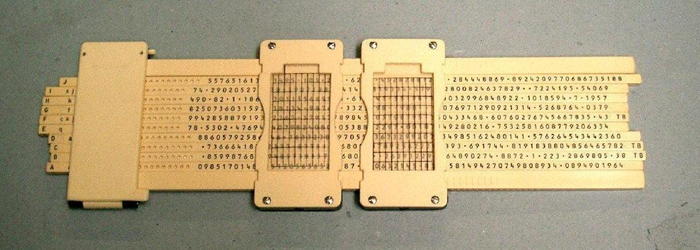
The Reihenschieber (slide shifter) was a German encryption device designed to generate random numbers for use in one-time pad (OTP) encryption. The Reihenschieber was introduced into service with the Bundeswehr in 1957 and remained in use until 1962. Although the concept was cryptographically sound, the device proved cumbersome and impractical in everyday operation. As a result, its deployment was relatively short-lived, and it never achieved widespread adoption.

The Reihenschieber (here at the BSI) served as a random number generator. Using ten numbered strips and a stencil, the operator could create a sequence of random digits (here 26 digits) at a time. To encrypt a message, the plaintext was first converted into a numerical sequence. The randomly generated digits were then added to this sequence using the principle of the one-time pad.
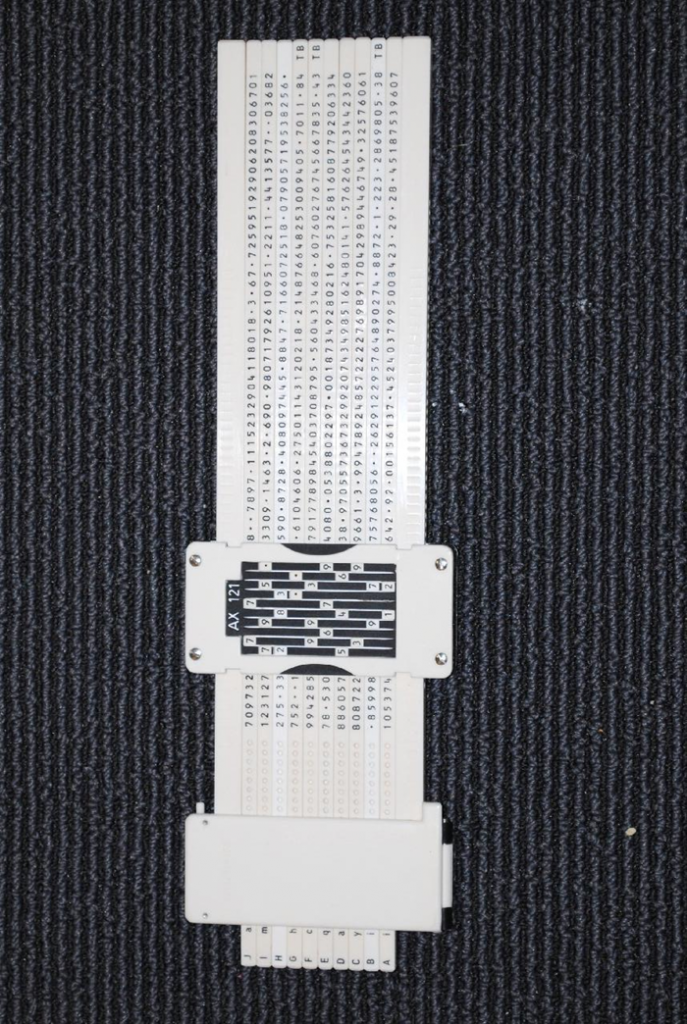
To decrypt a message, the recipient needed a Reihenschieber with the same configuration as the sender’s device. and configured in exactly the same way. This specimen is owned by the BSI.

The random sequence generated in this example is the following:
77627.84316.40..367061032.

This particular model (from the crypto museum) is equipped with two stencils instead of one. As a result, a single configuration can generate approximately twice as many random digits before the device has to be reconfigured. However, the overall security is reduced.

There are different variants of the Reihenschieber. This one is on display at the Museum für Kommunikation in Frankfurt.
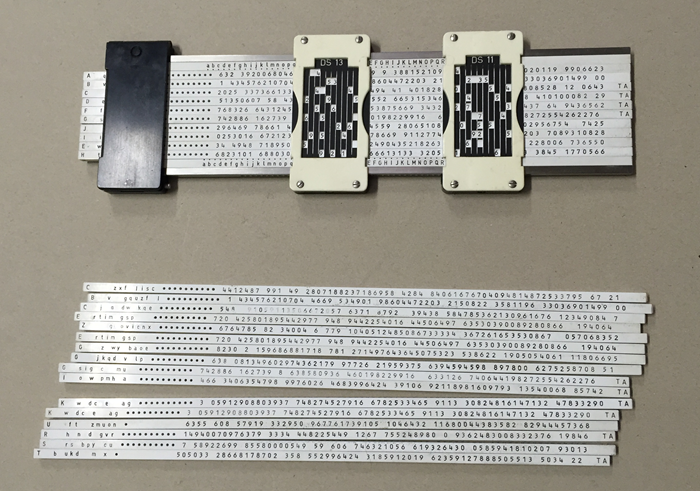
The security of the Reihenschieber (here at the Crypto Museum) is based on a remarkably large keyspace. The key consists of the following parts:
- Selection of ten rods from a set of 26 available square rods
- Order of the rods, since the ten selected rods can be arranged in many different ways
- Orientation of each rod, with four possible rotational positions for every rod
- Horizontal displacement of the rods, allowing additional variations in the generated digit sequences
- Selection of the stencil, as several different stencils were available for use
- Position of the stencil on the assembled rods

The individual displacement of the square rods forms an important part of the Reihenschieber’s (here at the Enigma Reunion 2009) key.
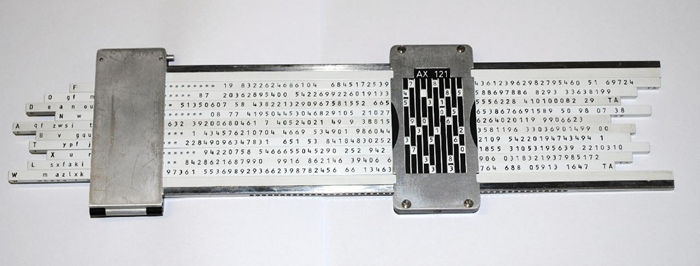
This is the reverse side of the Reihenschieber shown previously. As can be seen, the stencil can be used on both sides of the device.
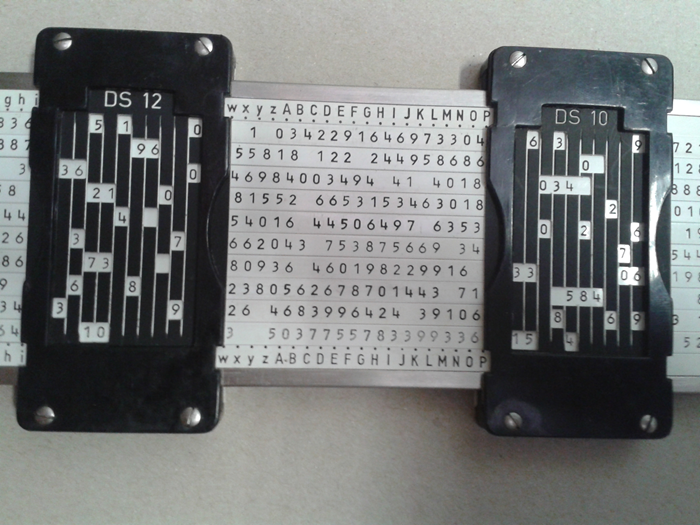
If the messages encrypted with a single configuration of the Reihenschieber (here at the Crypto Museum) are kept reasonably short, the device still provides a very high level of security by modern standards. The keyspace is far too large for a practical brute-force attack. Likewise, heuristic cryptanalytic methods such as hill climbing are unlikely to be effective.

A Reihenschieber (here at the BSI) with its additional rods

Although the Reihenschieber (here at the Crypto Museum) offered strong cryptographic security, it was extremely cumbersome to operate. The device itself merely generated the random digit sequences; the actual encryption and decryption process had to be carried out manually by the operator. Converting messages into numbers, adding the key stream, and reversing the process at the receiving end required considerable time and effort.
As a result, the Reihenschieber was unpopular among its users. During training exercises, personnel reportedly dispensed with Reihenschieber encryption altogether.

Despite its operational drawbacks, the Reihenschieber (here at the Enigma Reunion 2009) offered several practical advantages. The device was small, lightweight, robust, and inexpensive to manufacture, making it well suited for field use. Unlike complex mechanical cipher machines, it contained only a few simple components and required no power supply.

In museums and private collections, the Reihenschieber (this is another BSI specimen) often receives little attention. More elaborate cipher machines such as the Enigma tend to attract far greater interest.
The Reihenschieber is also frequently misunderstood. It is sometimes incorrectly described as a cipher slide operating on the same principle as a St. Cyr slide cipher. In reality, the device works in a completely different way. Outside the cryptologic community, the Reihenschieber is occasionally mistaken for a slide rule.

I built this LEGO version of the Reihenschieber to demonstrate the principle of the original device. Instead of generating random digits, it produces random letters. The sequence generated here is:
YSJV FHJT DVOC UXBI RAZG
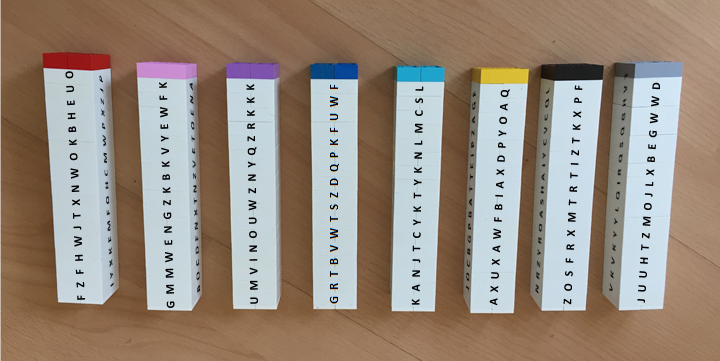
For the LEGO Reihenschieber, five rods must be selected from a set of eight square rods. Each rod can also be rotated around its own axis, providing four possible orientations per rod. Rotating a rod changes the arrangement of the digits visible through the stencil and therefore affects the random number sequence generated by the device.
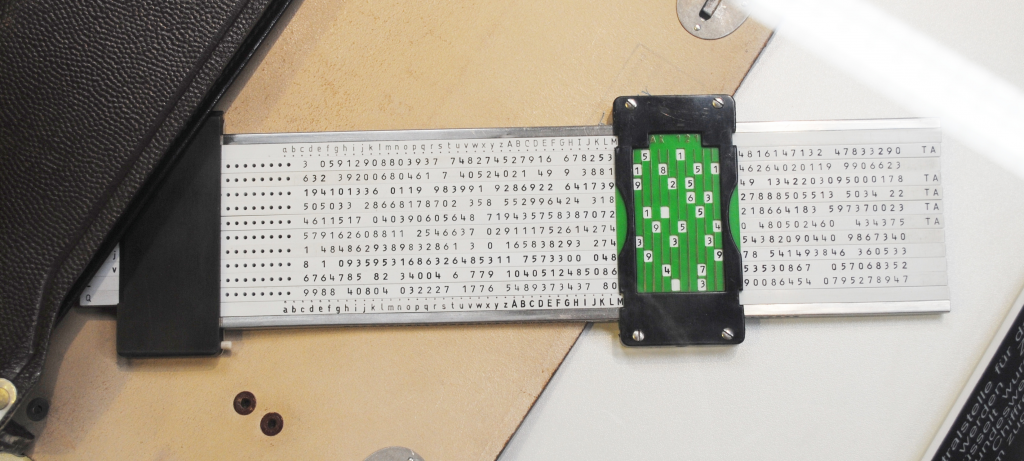
Unfortunately, it is not known how many Reihenschieber devices have survived to the present day. Likewise, there is no overview of the different Reihenschieber variants that were produced and used. This picture was taken at the Kryptologikum in Karlsruhe.
Back to Crypto Galleries