Petras Dominas’ encrypted notebooks
Petras Dominas was a dangerous criminal. He was born in Lithuania around 1929 and later worked as a typographer. He spoke several languages, including Lithuanian, German, English, Polish, and Dutch. His profession may have helped him develop an unusual sensitivity for symbols and their arrangement.
Little is known about his life before 1959. That year, he was convicted in Germany and sentenced to four years in prison. After his release, he soon returned to criminal activity. During 1963 and 1964, Dominas and his accomplices carried out a series of armed robberies in Germany and the Netherlands, mostly targeting jewelry stores. In September 1964, Dominas was arrested in Amsterdam, one day after another jewelry-store robbery.
The notebooks
In Dominas’ possession, the police found numerous encrypted notebooks. The first encrypted notes were reportedly discovered as early as 1959. More notebooks were later found in various hiding places associated with Dominas. In total, contemporary newspaper reports spoke of approximately twenty volumes.
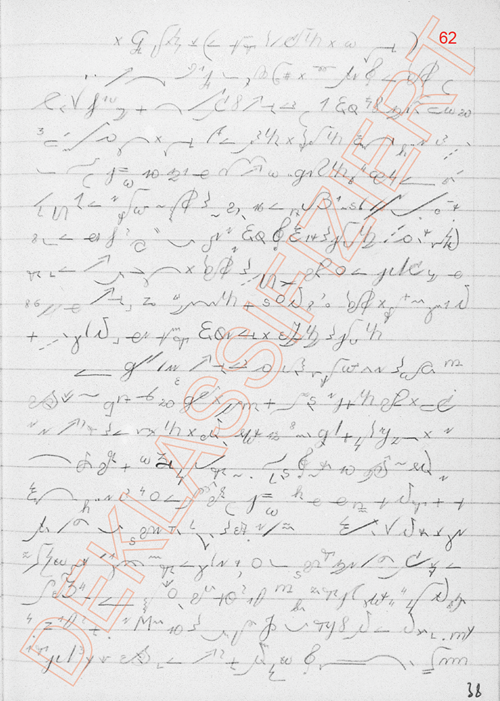
The notebooks were ordinary school exercise books and ledgers. Their appearance was surprisingly innocent. Dominas decorated their covers with children’s drawings and pressed flowers, making them look more like harmless personal notebooks than the records of a professional criminal.
The manuscripts had been created over a long period, from approximately 1952 to 1964. The writing did not resemble any known alphabet. Investigators initially suspected that Dominas might have modified a form of shorthand. A specialist in stenographic systems from Eastern Europe was consulted, but could not make sense of the writing.
Other experts were brought in. A Jordanian merchant and court interpreter examined the symbols for possible connections with Arabic writing – to no avail. Members of the Jewish community in Düsseldorf were asked whether the script resembled Hebrew or related alphabets. It did not. An expert in invisible inks examined the material and found no evidence of chemical or secret-ink techniques.
The police even searched the libraries of prisons in which Dominas had been incarcerated, hoping to find books that might have inspired his system. Nothing turned up. At one point, investigators confronted Dominas with samples of his own secret writing and asked him to translate them. According to a contemporary report, his answer was essentially that the police would never find the code.
Solved by the ZfCh
Eventually, the case was referred to the German authority responsible for cryptographic work, the Zentralstelle für das Chiffrierwesen (ZfCh) in Bonn.
From today’s perspective, it is surprising that this agency was not contacted earlier. In the 1960s, however, even the police apparently did not know that the ZfCh existed at all, as it operated under the strictest secrecy. The ZfCh succeeded in deciphering Dominas’s secret writing.
During an internet search in 2015, I came across a Spiegel article about Dominas that also mentioned his secret writing. The article included an image showing a small excerpt from one of the encrypted pages. The image below is AI-generated and does not reproduce the original image from the Spiegel article.
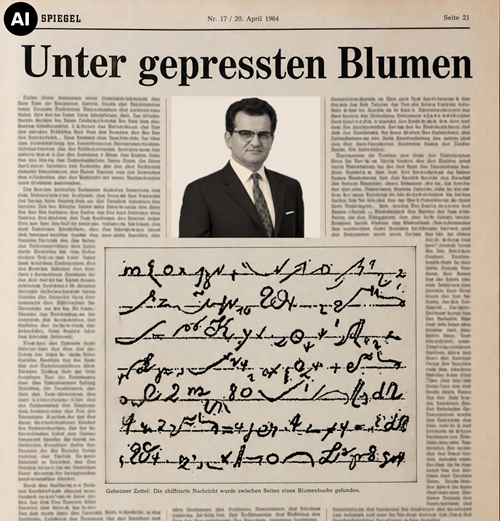
My further research revealed that, although the Dominas case had been covered extensively in the media and the secret writing was frequently mentioned, virtually nothing was publicly known about the cipher itself.
Thanks to a tip from a person whom I unfortunately cannot name here, I submitted a request to the BND archives in 2023 for information about the Dominas cipher. After almost two years, I actually received two detailed PDF documents.
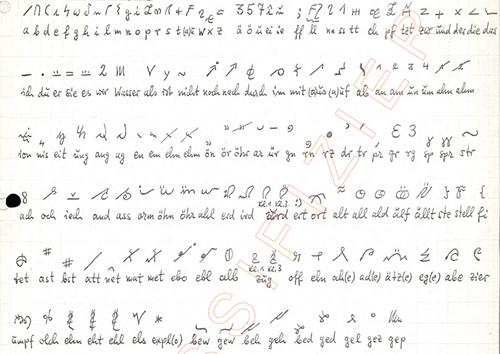
One of these PDFs is a 223-page collection of material. It includes Dominas’s handwritten descriptions of the cipher, a second treatise on his secret writing, and a list of cipher symbols and their meanings. The latter is essentially a cryptographic key.
The second PDF contains seventy pages of Dominas’s encrypted notes. These seventy pages probably represent only a small fraction of the approximately twenty notebooks that once existed.
Dieter Bäusch
As I learned from the material, a ZfCh employee named Dieter Bäusch was responsible for breaking the Dominas cipher. I had never come across this name before. Dieter Bäusch is not mentioned in the crypto literature that I am aware of.
Unfortunately, we do not know exactly how Bäusch broke the cipher. His surviving notes do not provide a complete account of the cryptanalytic process. He presumably performed a frequency analysis. This must have been difficult because of the enormous number of different symbols: there were more than one thousand. He probably also tried to guess words. This was made more difficult by the fact that there are no cleartext passages in the encrypted text.
Several possibilities had to be considered. Perhaps the system was homophonic, meaning that several symbols represented the same plaintext letter. Some symbols might also represent complete words or syllables rather than individual letters. In the end, both assumptions turned out to be correct.
Apparently, Bäusch compared encrypted passages that appeared to contain the same or similar plaintext. This allowed him to study the differences between corresponding ciphertext passages. Some passages occurred twice or even several times in the notebooks. Dominas may have copied sections of text as exercises while developing new symbols for his system.
As it turned out, the Dominas system was essentially a monoalphabetic substitution cipher in which a symbol could represent a single letter, a syllable, a combination of letters, a complete word, or a punctuation mark. There was no transposition, and capitalization was not relevant either.
A cipher that evolved
The system was not static. Dominas appears to have developed and modified it over many years. The earliest known version dates from around 1952. At this stage, the size and position of symbols were apparently irrelevant, while punctuation marks and numbers remained unencrypted.
Around 1959, Dominas changed the system substantially. Dot markings were largely abandoned, while the size and position of symbols became significant. Some symbols also received new meanings. After 1960, he added a few more symbols, although the basic system otherwise remained relatively stable.
Some symbols changed their meaning. Others were added or discarded. Some symbols differed only in size, position, or stroke thickness. And because Dominas apparently was the only person who ever used the system, there was little reason for him to make it completely consistent.
Interestingly, the number of symbols representing a letter does not appear to correspond to the letter’s frequency in German. The letter E, for example, has only two representations. The much less frequent letter D has four. These four symbols are rotated versions of the letter U. This suggests that Dominas was not primarily trying to construct a statistically balanced cipher. Geometric and aesthetic considerations appear to have played an important role.
What did Dominas write?
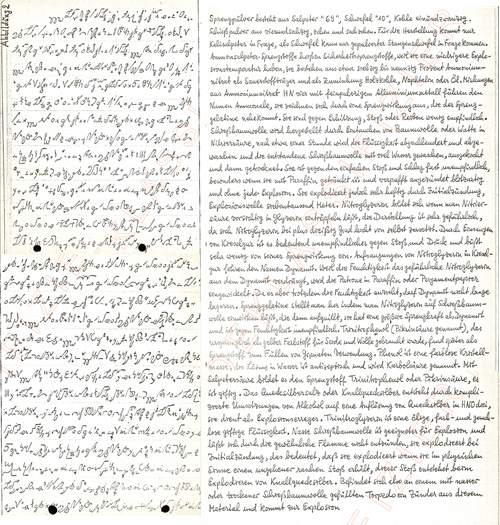
The encrypted notes are sometimes described as a diary. That description is misleading. The material available today shows that Dominas wrote several different kinds of texts. Some passages contain detailed accounts of criminal activities. Others concern his legal representation. There are also personal reflections, observations, and narrative fragments.
Open questions
The decipherment of Dominas’s secret writing answered one question, but left several others open:
- How exactly did Dieter Bäusch break the system?
- What do the remaining encrypted notebooks contain?
- How many of Dominas’s original notebooks still exist?
- And what happened to Dominas after his arrest and subsequent imprisonment?
I hope these questions can be answered one day.
Literature
Klaus Schmeh: The Encrypted Notes of Murderer Petras Dominas. HistoCrypt 2026
Back to Unsolved Crypto Mysteries