Edward Hebern’s encryption machines
Edward Hebern (1869–1952) was an American inventor and cryptography pioneer who developed one of the first rotor cipher machines. He founded the Hebern Electric Code Company in California and sought to market his machines to governments, businesses, and the military. His inventions introduced the wired rotor principle that later became the foundation of many famous cipher machines, including the German Enigma and the American SIGABA.
Despite his technical ingenuity, Hebern failed to turn his inventions into a lasting commercial success. His machines received only limited adoption, and his company eventually collapsed amid financial difficulties. Nevertheless, his rotor principle became one of the most influential innovations in the history of cryptography and paved the way for many of the cipher machines used during World War II.
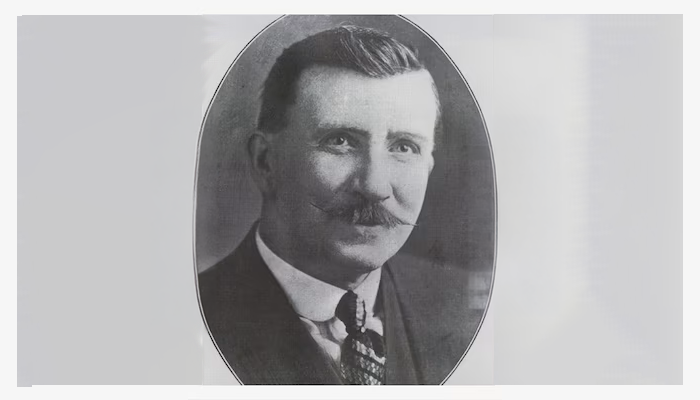
Edward Hugh Hebern was born in 1869 in Streator, Illinois. He later earned his living as a carpenter and building contractor. It has been suggested that his fascination with cryptography began while he was serving a prison sentence for horse theft.

To market his cipher machines, Edward Hebern founded the Hebern Electric Code Company. Although Hebern succeeded in attracting substantial investment capital, his business never achieved the commercial success he had envisioned.
The former company headquarters can still be seen today at 829 Harrison Street in Oakland, California. Construction began in 1922. The building was designed on a remarkably grand scale, with enough space to accommodate 1,500 workers, and it featured a luxurious private office for Hebern himself.

One of Hebern’s earliest patents described an auxiliary keyboard that could be placed on top of a standard typewriter keyboard. By remapping the keys, the device enabled the user to produce encrypted text directly while typing.

This drawing from a 1924 patent shows one of Edward Hebern’s rotor cipher machines.

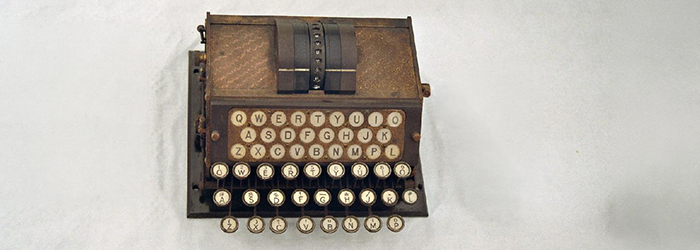
This early Hebern cipher machine (at the National Cryptologic Museum in Fort Meade, MD) employs only a single rotor. Its appearance closely matches the illustration shown in Hebern’s patent, suggesting that it was built during the initial phase of development. The machine lacks the polished look of later models and was most likely intended as a prototype.
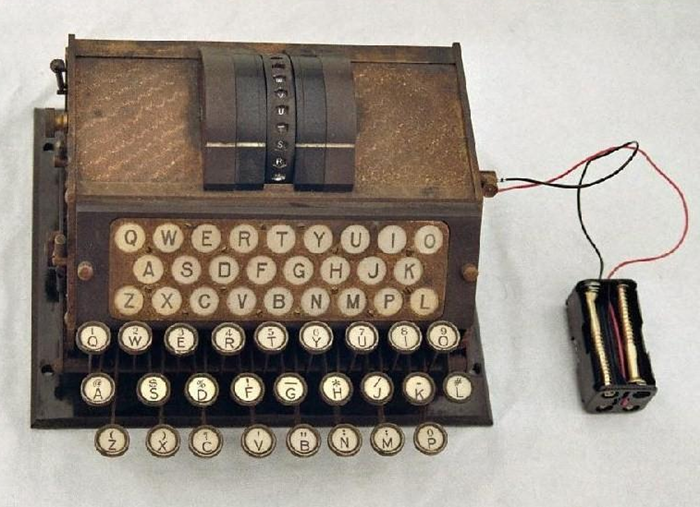
This early Hebern cipher machine also employs only a single rotor. Its rather experimental appearance suggests that it, too, was a prototype.
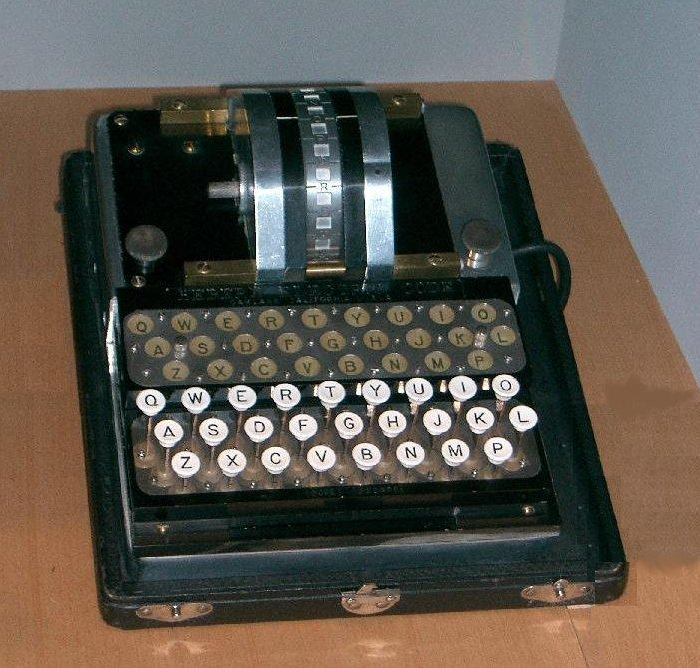
This single-rotor Hebern cipher machine is exhibited at the Heinz Nixdorf MuseumsForum in Paderborn, Germany. In contrast to many surviving Hebern machines, which are unique specimens and often display prototype-like features, this example appears remarkably polished and production-ready. It reflects the high level of engineering that Hebern’s company was able to achieve despite its limited commercial success.

Hebern soon realized that a single rotor did not provide sufficient cryptographic strength. This later machine (at the Charlotte Crypto Symposium) therefore employs three rotors, which advance according to the odometer principle: the first rotor moves with every keypress, while the others advance only after the preceding rotor has completed a full revolution. The resulting increase in complexity dramatically enlarged the key space and made cryptanalysis far more difficult.
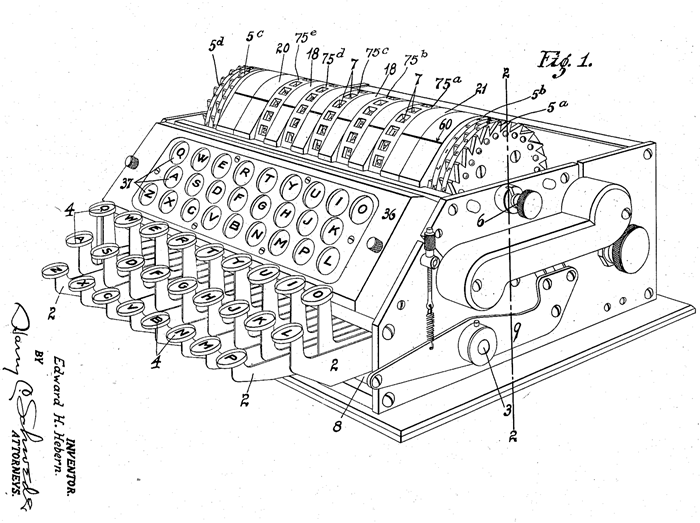
This drawing depicts a Hebern cipher machine equipped with five rotors.
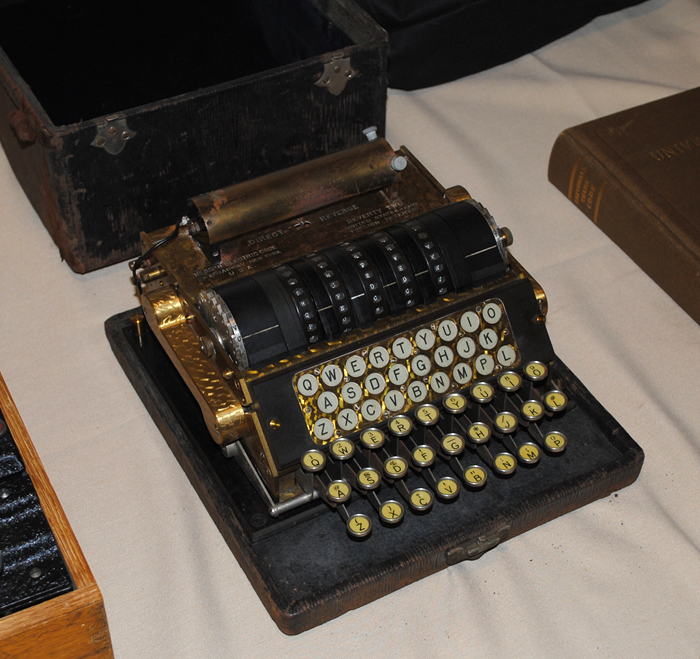
Today, less than twenty Hebern cipher machines are thought to exist. Almost every surviving specimen is unique. Among collectors, Hebern machines rank among the most elusive treasures.
A rare opportunity to acquire one arose in 2025, when Sotheby’s offered a three-rotor Hebern machine at auction. The estimated value of $40,000 to $60,000 appeared remarkably low given the machine’s significance. The hammer price has not been disclosed.
Literature
Back to Crypto Galleries