The encrypted messages of Nazi spy Walter Köhler
In 2000 David Kahn published his book Hitler’s Spies, which tells the story of the “Abwehr” and other German secret services in the Third Reich. David’s original impression was that Hitler had operated a sophisticated spy network working professionally and employing skilled people. However, during research for Hitler’s Spies, David more and more realized that intelligence work under Hitler was quite amateurish and poorly organized. Apart from the Abwehr, several other secret services were involved in espionage. The existence of several competing organisations, which didn’t cooperate, considerably weakened the German intelligence efforts. All in all, Hitler’s spies were not very successful. All this is described in Hitler’s Spies in great detail.
As David reports in his book, the Abwehr recruited a spy code-named “Köhler” in New York City. According to Hitler’s Spies, not much is known about this person. However, blog reader Max Baertl pointed out that Köhler might be identical with Nazi spy Walter Köhler (sometimes spelled “Koehler”), who is described in an online article published in 2007. As it seems, David was not aware of this Walter Köhler, when he wrote his book.
The Köhler cryptograms
Already in 1981, David Kahn published five encrypted messages sent by or referring to Köhler from February 1944, kept by the British National Archive. According to David’s publication, these messages were sent from “the Abwehrs main radio overseas post” (probably a place in the U.S.). They are quoted in a letter addresses to “Paris Funkstelle”, but the final destination was Hamburg. Here is the letter (the numbers indicate the length of the respective message):
An
Abwehrleitstelle Frankreich
Paris Funkstelle
Sofort vorlegen!
Betr.: Koehler
237
Ybtat mqfvo dvbis prito kecqg kokik kyiwm zuarj
alyia qtxvi vxzya szgou skiqn rbqjq mogex ezdnf
vusda zurop ixklo cmnbl grdhz swmch kupef pzlej
hbord wkkhu vthjk sfwda jepmu izvig kzlau rdrxx
mdecs spozv eeeod dlmdz nqmia pidwg xdcyy mvkso
hmmii impwq nkipa mljvm sqsbb glevn sktlq tn.
178
Eekao parwo xiavy pejux lhnjh pbqdd vdvxb mdiia
gwwmn zbivm abuws dwoug djozl ylaug loaea ilihj
swjft oetad tjisn avaqn sodwb wzaxe zvoxg xpgzv
adurm shvxx xfmuq pdpvq dqwtu fryok xfvcp ydzwm
ofwfl uzfne qsslo evl.
137
tziqb lqqxs kinod mbvil sukms syarh mhzvp tvswm
ayddg rixyy omfzm ugfzz aznqe ljuyi ygwuo qmdbi
vcxgz rmzno pessh gpoyx qqlei xmaoj buugz czfdl
yzmkp gsmfm dteze oxmos.
140
dmxkb kqnvh zzeek beoop ygcca yvepv tykmt iykfl zkacv
uxiyd kruwy vnjvp xyeqp jpmfo abzpt mjtdy zvzky bjgze
vdtyd zeejw zumjp ivsna gsmzq dltxb qjqqj fnpta mqted
skijj.
229
fpoxa tijyp qrerq znqst zasnk zarvq hhsmw vlhfg pyhqc
yuirf fsgoi twgdg sbphc fkfza bpegh jzujn wtsxp ijamg
tzdto hxzdn uivww tizoc axkye lhmdn sfzjo omrhb zpith
hklsf anvdr ynhqk syrgi ltxos wabom dzwlb byava sjomn
qqszs adddu greao alhon lxzgi iwpnf uzgui jgmya ksqfw
zsjl.
Abwehrstelle im Wehrkreis X
Nr.168/44 Funkleiter Übersee geh.
5.2.44 1:25
These exciting crypto-puzzles have never been much appreciated in the literature. My blog post from 2013 (in German) seems to be the only publication in the last 30 years that even mentions these cryptograms. Their plaintext is still unknown.
Analysis
Let us first take a look at the frequencies of letters and letter pairs (determined using the software CrypTool):
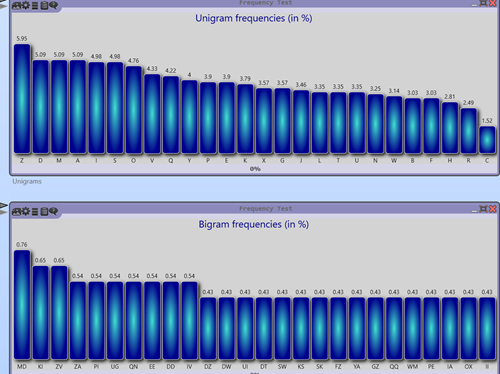
The distribution is relatively flat. This suggests that no simple substitution cipher was used. A transposition cipher does not seem to fit either. A Vigenère cipher is at least unlikely.
I do not know whether Köhler himself encrypted these messages. It is equally possible that the sender of the letter performed the encryption. If so, an Abwehr Enigma may have been used. Perhaps an Enigma expert can determine whether these messages are consistent with encryption by an Enigma machine.
If Köhler himself was the encipherer, however, it seems unlikely that he used an Enigma machine. An Enigma would have been too expensive and too conspicuous. So what else could it have been? Readers of my blog have suggested several possibilities, including:
- One-time pad: This method was not yet widely used during the Second World War, but it cannot be ruled out.
- Book cipher: Such ciphers are usually represented with numbers. For example, 12345 might refer to the 45th letter on page 123 of a book. That does not fit the present case.
- Codebook: Some codebooks contain five-letter code groups. However, in such systems, messages often end with shorter letter groups. Since this is not the case here, it suggests that the encryption was applied letter by letter rather than word by word. A codebook therefore seems unlikely.
Nazi spies used a wide variety of methods. In a talk I gave at the EuroHCC 2017, I listed, among others, the following (there were certainly more):
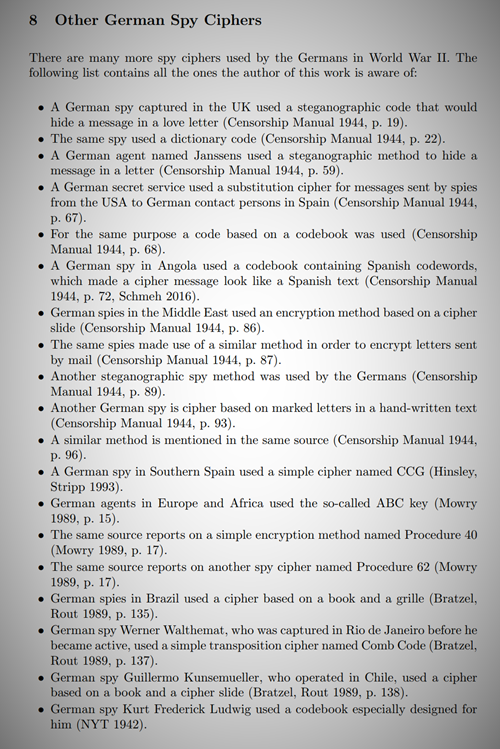
Most of these methods were relatively simple and not particularly secure. Overall, the chances are therefore quite high that the Köhler cryptograms can be broken. The first challenge, however, is to determine which encryption method was used. The steganographic techniques listed above can be ruled out, and book ciphers also seem unlikely.
Any further clues or ideas that might help solve this puzzle are very welcome.
Literature
David Kahn: Hitler’s Spies: German Military Intelligence in World War II. Da Capo Press 2000
Klaus Schmeh: German Spy Ciphers of World War II. EuroHCC 2017
Back to Unsolved Crypto Mysteries